Naming organic compounds
The three parts of a name
Every IUPAC name is built the same way:
-
The stem says how many carbons are in the longest chain — meth, eth, prop, but, pent, hex, hept, oct.
-
The suffix names the highest-priority functional group, with a number saying where it is.
-
Prefixes name everything else — branches, halogens and lower-priority groups — each with its own number.
-
The standard restricts you to chains of no more than eight carbons.
The method
-
Find the longest continuous carbon chain that contains the principal functional group. That gives the stem.
-
Identify the highest-priority functional group present. That becomes the suffix.
-
Number the chain from whichever end gives the suffix group the lowest possible number.
-
Name everything else as a prefix, with its number, and put the prefixes in alphabetical order.
-
Numbers are separated from words by hyphens and from other numbers by commas: 2,3-dimethylbutan-1-ol.
Which group wins
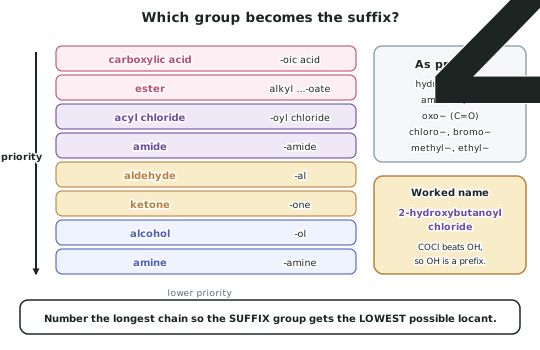
Highest priority first:
-
carboxylic acid → -oic acid
-
ester → alkyl ...-oate
-
acyl chloride → -oyl chloride
-
amide → -amide
-
aldehyde → -al
-
ketone → -one
-
alcohol → -ol
-
amine → -amine
-
Only the highest one present becomes the suffix. Everything else becomes a prefix:
- → hydroxy-
- → amino-
- (as a ketone) → oxo-
- , → chloro-, bromo-
- alkyl branches → methyl-, ethyl-
-
So is 2-hydroxybutanoyl chloride — the acyl chloride outranks the alcohol, so the –OH is demoted to a prefix.
Groups that need no number
- An aldehyde, a carboxylic acid, an acyl chloride and an amide are always at the end of a chain, so their carbon is always carbon 1 and no locant is written.
- Write propanal, not "propan-1-al"; butanoic acid, not "butan-1-oic acid".
Naming esters
-
An ester name has two words, and they come from the two parts in a specific order:
- the first word is the alkyl group from the alcohol
- the second word comes from the acid, ending -oate
-
is methyl propanoate — the on the oxygen came from methanol, and the three-carbon acid part is propanoate.
-
The alkyl group named first is the one attached to the oxygen, not the one attached to the carbonyl. Getting these the wrong way round is the most common ester-naming error.
Naming amines
- The 2026 specification restricts systematic naming to primary amines.
- Name them as the alkane with -amine as the suffix and a locant: is propan-1-amine.
- When an amine group is not the principal group it becomes the prefix amino-: is 2-aminoethanoic acid.
Worked ExampleNaming and drawing
(a) Give the IUPAC name of . (b) Give the IUPAC name of . (c) Draw the structural formula of ethyl 3-hydroxybutanoate.
(a)
Step 1 — Find the principal group and the longest chain containing it. The only functional group is the –OH, so the suffix is -ol.
The longest chain through that –OH runs : four carbons, so the stem is butan.
Step 2 — Number to give the –OH the lowest locant. Numbering from the –OH end puts it on carbon 1. Numbering from the other end would put it on carbon 4, so the first is correct.
Step 3 — Name the branch. With that numbering, the branch sits on carbon 3, giving 3-methyl.
(b)
Step 1 — Identify all the groups. There is an aldehyde () and an amine ().
Step 2 — Apply the priority order. Aldehyde outranks amine, so the suffix is -al and the amine is demoted to the prefix amino-.
Step 3 — Number the chain. The chain is four carbons long, so the stem is butan. The aldehyde carbon is always carbon 1, so no locant is needed for it.
Counting from the aldehyde: C1 is the CHO, C2 carries the .
(c) Drawing ethyl 3-hydroxybutanoate
Step 1 — Split the ester name into its two parts.
- "ethyl" is the alkyl group attached to the oxygen, so it comes from ethanol:
- "3-hydroxybutanoate" is the acid part: a four-carbon chain (butan) ending in the ester carbonyl, with an –OH on carbon 3
Step 2 — Build the acid part, numbering from the carbonyl. C1 is the carbonyl carbon, C2 is , C3 carries the –OH, C4 is .
Step 3 — Attach the ethyl group through the oxygen.