Reactions of alcohols
Four routes out of an alcohol
Alcohols sit at the centre of the reaction map, and there are four things you can do to one.
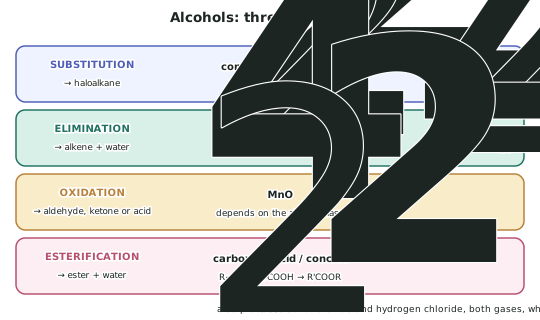
- Substitution → a haloalkane
- Elimination → an alkene
- Oxidation → an aldehyde, ketone or carboxylic acid
- Esterification → an ester
Substitution: replacing the –OH with a halogen
Three reagents do this, and all three appear on the standard's list.
- Concentrated HCl gives a chloroalkane:
- HBr gives a bromoalkane:
- Thionyl chloride, , gives a chloroalkane:
- is the best of the three, because both by-products are gases that escape from the mixture, so the reaction goes to completion and the product is easy to purify.
- The functional group stays on the same carbon — substitution never moves it.
Elimination: removing water to make an alkene
- Reagent: concentrated sulfuric acid, with heat.
-
The –OH and a hydrogen from the neighbouring carbon are removed as water, and a double bond forms between those two carbons.
-
This is also called dehydration, because water is lost.
-
If the two neighbouring carbons are different, two alkenes form — see the next page.
-
Do not confuse the eliminating reagents. Concentrated eliminates from an alcohol; KOH in alcohol eliminates from a haloalkane.
Oxidation
- Reagents: acidified permanganate, , or acidified dichromate, .
- What you get depends entirely on whether the alcohol is primary, secondary or tertiary — covered in full on the oxidation page.
Esterification
- An alcohol reacts with a carboxylic acid, catalysed by concentrated sulfuric acid, to give an ester and water.
- The reaction is reversible, so it does not go to completion.
- An alcohol also reacts with an acyl chloride to give an ester, and that reaction is not reversible, so it gives a better yield.
Which reactions depend on the class of alcohol
| Reaction | Depends on 1°/2°/3°? |
|---|---|
| substitution | No — all classes react |
| elimination | No — all classes with a neighbouring H react |
| oxidation | YES — this is the one |
| esterification | No |
- So classify the alcohol before answering an oxidation question, and do not waste time doing so for the others.
Worked ExampleOne alcohol, four reagents
Give the structural formula and name of the organic product when butan-1-ol, , is treated with each reagent.
(a) (b) concentrated , heated (c) , heated under reflux (d) ethanoic acid with a few drops of concentrated , heated under reflux
(a)
Step 1 — Identify the reaction. Thionyl chloride replaces an –OH with a –Cl. This is a substitution.
Step 2 — Write the equation, keeping the group on carbon 1.
(b) Concentrated , heated
Step 1 — Identify the reaction. Concentrated sulfuric acid with heat, and no other reactant present, means elimination (dehydration).
Step 2 — Find where the double bond forms. The –OH is on carbon 1. Its only neighbour is carbon 2, so the hydrogen must come from there and the double bond forms between C1 and C2.
(c) , heated under reflux
Step 1 — Classify the alcohol. The carbon bearing the –OH is attached to one other carbon, so butan-1-ol is a primary alcohol.
Step 2 — Note the conditions. Reflux with the oxidant means the oxidation goes all the way. Distilling instead would stop it at the aldehyde.
Step 3 — Give the product. A primary alcohol under reflux is oxidised to a carboxylic acid.
(d) Ethanoic acid with concentrated , refluxed
Step 1 — Identify the reaction. Here the sulfuric acid is present with a carboxylic acid, so it is acting as a catalyst for esterification — not as an eliminating agent.
Step 2 — Build the ester. The acid supplies the acyl part (, from ethanoic acid) and the alcohol supplies the alkyl group on the oxygen (, from butan-1-ol).