Aldehydes and ketones
The one structural difference
-
Both contain a carbonyl group, .
-
An aldehyde has the carbonyl at the end of the chain, so that carbon carries a hydrogen.
-
A ketone has the carbonyl within the chain, so that carbon carries two carbons and no hydrogen.
-
That single hydrogen is the whole of their different chemistry. An aldehyde can be oxidised; a ketone cannot.
Oxidation: the dividing line
- Oxidising a carbonyl compound to a carboxylic acid means attaching an –OH to the carbonyl carbon, which requires a hydrogen there to be replaced.
- An aldehyde has one, so it is oxidised:
- A ketone has none, so it is not oxidised — the only way would be to break a strong carbon–carbon bond.
The three tests that separate them
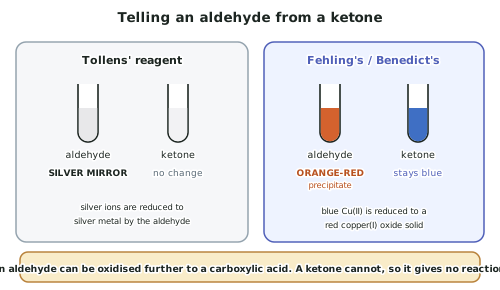
| Reagent | With an aldehyde | With a ketone |
|---|---|---|
| Tollens' reagent | silver mirror forms | no change |
| Fehling's or Benedict's | orange-red precipitate | stays blue |
| orange → green | stays orange | |
| purple → colourless | stays purple |
- All four work the same way: the aldehyde is oxidised and the reagent is reduced, and it is the reagent's change that you see.
What is happening in each test
-
Tollens' reagent contains silver(I) ions. The aldehyde reduces them to silver metal, which deposits as a mirror on the glass.
-
Fehling's and Benedict's contain copper(II) ions, which give the solutions their blue colour. The aldehyde reduces them to copper(I) oxide, an orange-red solid.
-
Dichromate and permanganate are stronger oxidising agents, and their colour changes are the ones you have already met with alcohols.
-
Tollens', Fehling's and Benedict's are mild oxidising agents — mild enough that they do not oxidise alcohols. That makes them specific to the aldehyde.
Reduction with sodium borohydride
-
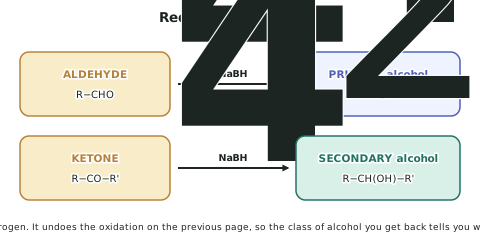
reduces both aldehydes and ketones, adding hydrogen across the .
-
aldehyde → primary alcohol:
-
ketone → secondary alcohol:
-
Reduction is the exact reverse of the oxidation that made them, so the class of alcohol you get back tells you which carbonyl you started with.
Worked ExampleWorking backwards from test results
Two compounds, X and Y, both have the molecular formula and both contain a carbonyl group.
- X gives a silver mirror with Tollens' reagent.
- Y gives no change with Tollens' reagent.
- Both are reduced by ; X gives butan-1-ol and Y gives butan-2-ol.
Identify X and Y, and explain how each piece of evidence supports your answer.
Step 1 — Use the Tollens' results to assign the families
A silver mirror with Tollens' is a positive test for an aldehyde, because only an aldehyde has a hydrogen on the carbonyl carbon that allows it to be oxidised, reducing the silver(I) ions to silver metal.
- X gives a mirror → X is an aldehyde.
- Y gives no change → Y is a ketone, since its carbonyl carbon has no hydrogen and cannot be oxidised.
Step 2 — Use the reduction products to fix the structures
adds hydrogen across the , so reduction is the reverse of the oxidation that formed the carbonyl compound. The position of the –OH in the alcohol shows where the carbonyl was.
X → butan-1-ol, . The –OH is on carbon 1, so the carbonyl was on carbon 1 — the end of the chain, confirming an aldehyde.
Y → butan-2-ol, . The –OH is on carbon 2, so the carbonyl was on carbon 2 — within the chain, confirming a ketone.
Step 3 — Check for consistency
- Both structures are ✓
- Butan-1-ol is a primary alcohol, which is what reducing an aldehyde must give ✓
- Butan-2-ol is a secondary alcohol, which is what reducing a ketone must give ✓