Reaction pathways and synthesis
What a synthesis question asks
- You are given a starting material and a target, and must supply the reagents, conditions and structure of the product after each step.
- These are the highest-tariff questions on the paper, and they test the reaction map rather than any new chemistry.
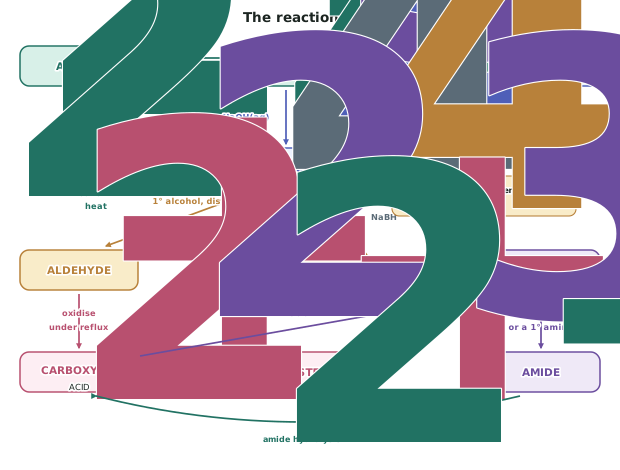
Work backwards
Forwards is guessing; backwards is deduction.
-
Look at the target and ask: what makes this functional group?
-
Usually there are only one or two answers, so you have immediately halved the problem.
-
Repeat for that intermediate, and keep going until you reach something you can make from the starting material.
-
Then write the scheme forwards, with reagents and conditions at every arrow.
-
For example, to reach an amide the only route on this course is from an acyl chloride — so the step before the amide is fixed before you have thought about anything else.
The routes into each group
| To make a... | You need... |
|---|---|
| haloalkane | an alcohol (conc HCl, HBr, ) or an alkene (+ HX) |
| alcohol | a haloalkane (), an alkene (), or a carbonyl () |
| alkene | an alcohol (conc ) or a haloalkane (KOH in alcohol) |
| aldehyde | a primary alcohol, oxidised and distilled off |
| ketone | a secondary alcohol, oxidised |
| carboxylic acid | a primary alcohol or an aldehyde, oxidised under reflux |
| acyl chloride | a carboxylic acid + |
| ester | an acid + alcohol (), or an acyl chloride + alcohol |
| amide | an acyl chloride + or a primary amine |
| amine | a haloalkane + conc |
Two things that catch people out
- Some targets need the starting material in two portions. An ester built from an acid and an alcohol that both derive from the same source needs the material split, with one portion oxidised and the other kept as the alcohol.
- Some proposed steps do not exist. An aldehyde does not react with an alcohol to make an ester; you must oxidise it to the acid first. Check every step against the map rather than assuming a plausible-looking conversion is real.
Presenting your answer
- Draw a flow scheme, one arrow per step.
- Write the reagent and the conditions above each arrow.
- Draw the structural formula of the organic product after each step.
- Never skip a step to save time — each one carries marks.
Worked ExampleA four-step synthesis
Devise a reaction scheme to convert 1-bromobutane into N-methylbutanamide, . For each step give the reagents, the conditions and the structural formula of the organic product. Methylamine, , is available.
Step 1 — Plan by working backwards
The target is an amide. On this course an amide is made in only one way: from an acyl chloride plus ammonia or a primary amine. Since the target has an N-methyl group, the amine must be methylamine.
How do I get butanoyl chloride? An acyl chloride is made from a carboxylic acid with .
How do I get butanoic acid? A carboxylic acid comes from oxidising a primary alcohol under reflux.
How do I get butan-1-ol? An alcohol comes from a haloalkane with aqueous hydroxide — and 1-bromobutane is exactly that.
The chain of reasoning is complete. Now write it forwards.
Step 2 — 1-bromobutane → butan-1-ol
Reagents and conditions: , warmed. The solvent must be aqueous so that substitution occurs rather than elimination.
Step 3 — butan-1-ol → butanoic acid
Butan-1-ol is a primary alcohol, so oxidation can go to the acid.
Reagents and conditions: acidified potassium dichromate, , heated under reflux with the oxidant in excess.
Reflux is essential. Distilling would remove butanal before it could be oxidised further, and an aldehyde is no use for the next step.
The solution turns orange to green.
Step 4 — butanoic acid → butanoyl chloride
Reagent: thionyl chloride, .
Both by-products are gases, so they escape and the reaction goes to completion.
Step 5 — butanoyl chloride → N-methylbutanamide
Reagent: methylamine, , at room temperature.
Step 6 — Check the whole scheme