Major and minor products of elimination
When two alkenes are possible
-
Elimination removes a hydrogen and a leaving group from adjacent carbons, forming a double bond between them.
-
If the carbon carrying the –OH or halogen has two different neighbouring carbons, the hydrogen can come from either, so two different alkenes form.
-
The standard calls these the major and minor products, and it names the source as asymmetric alcohols and haloalkanes.
-
If both neighbours are identical, only one alkene is possible and there is no major/minor distinction.
The rule
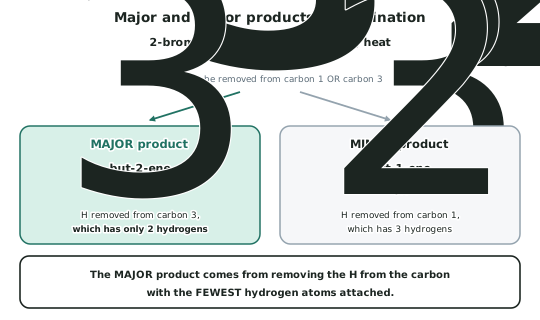
The major product is formed by removing the hydrogen from the carbon with the FEWEST hydrogen atoms attached.
- The minor product comes from removing a hydrogen from the carbon with more hydrogens.
- Both products do form — the question is which one forms in the greater amount.
Working one out
- Find the carbon carrying the –OH or the halogen.
- List its neighbouring carbons and count the hydrogens on each.
- Major product: form the double bond towards the neighbour with fewer hydrogens.
- Minor product: form the double bond towards the neighbour with more hydrogens.
- Name both alkenes.
The standard example
For 2-bromobutane, :
| Neighbour | Hydrogens on it | Product | Which |
|---|---|---|---|
| C3 () | 2 | , but-2-ene | MAJOR |
| C1 () | 3 | , but-1-ene | minor |
- Note that the numbering is from the end that gives the bromine the lower locant, so the next to the CHBr is C1 and the is C3.
The same rule for alcohols
- Alcohols dehydrated with concentrated follow exactly the same rule.
- For pentan-2-ol, :
- C3 is a with 2 hydrogens → pent-2-ene, the major product
- C1 is a with 3 hydrogens → pent-1-ene, the minor product
Cis and trans among the products
- If the major alkene has two different groups on each carbon of its double bond, it will itself exist as cis and trans forms.
- But-2-ene, for instance, forms as a mixture of cis-but-2-ene and trans-but-2-ene.
- You will not normally be asked which of those predominates, but you may be asked to note that both exist.
Worked ExamplePredicting major and minor products
2-methylbutan-2-ol, , is heated with concentrated sulfuric acid. Draw and name the major and minor organic products, and justify your assignment.
Step 1 — Draw the skeleton and number it
The parent chain is butan (four carbons), the –OH is on carbon 2, and there is a methyl branch also on carbon 2.
Step 2 — Identify the carbon bearing the –OH and list its neighbours
The –OH is on carbon 2. The carbons adjacent to it are:
- carbon 1, a group
- carbon 3, a group
- the methyl branch on carbon 2, also a group
Step 3 — Count the hydrogens on each
| Neighbour | Type | Hydrogens |
|---|---|---|
| carbon 1 | 3 | |
| the methyl branch | 3 | |
| carbon 3 | 2 |
Note that carbon 1 and the methyl branch are equivalent — both are methyl groups attached to carbon 2 — so removing a hydrogen from either gives the same alkene. There are therefore only two distinct products, not three.
Step 4 — Apply the rule
The major product comes from the neighbour with the fewest hydrogens, which is carbon 3 with two.
Forming the double bond between C2 and C3:
The minor product comes from a methyl neighbour, which has three hydrogens.
Forming the double bond between C2 and C1:
Step 5 — State the justification
The major product is 2-methylbut-2-ene because it is formed by removing a hydrogen from carbon 3, which carries only two hydrogens — fewer than the three on either methyl group.