The reaction map
Why this page exists
- Almost every question in this paper asks you to move from one functional group to another.
- There are only about fifteen conversions in the whole standard, and they fit on a single diagram.
- Learn this map and you can answer a synthesis question you have never seen before.
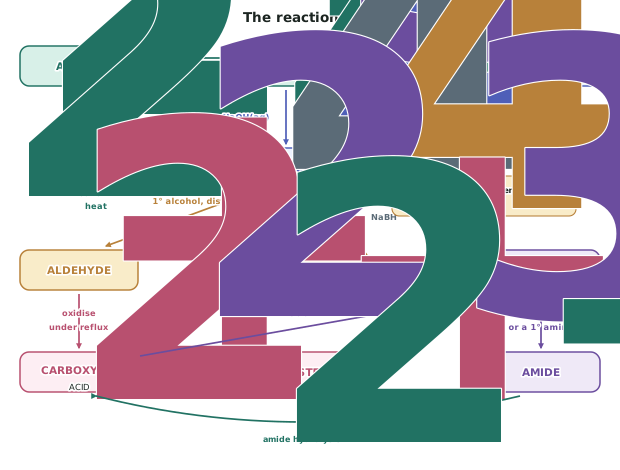
The conversions, by starting material
From an alkene
- → haloalkane
- → alcohol
From a haloalkane
- or , warm → alcohol (substitution)
- KOH in alcohol, heat → alkene (elimination)
- conc , heat in a sealed tube → primary amine
From an alcohol
- conc HCl, HBr or → haloalkane
- conc , heat → alkene (elimination)
- or → aldehyde, ketone or carboxylic acid
- carboxylic acid / conc → ester
From an aldehyde or ketone
- or , reflux → carboxylic acid (aldehyde only)
- → back to the alcohol
From a carboxylic acid
- → acyl chloride
- alcohol / conc → ester
From an acyl chloride
- alcohol → ester
- conc or a primary amine → amide
Back to the acid
- an ester or an amide or → hydrolysis
Three patterns worth noticing
- Alcohols are the hub. Almost every route passes through an alcohol, so if you are stuck in a synthesis, ask how to get to one.
- Oxidation goes one way, reduction comes back. Alcohol → aldehyde → acid climbs the ladder; comes back down one rung.
- Every acid derivative hydrolyses back to the acid. Esters, amides and acyl chlorides all return to with water.
The conditions are half the answer
Two pairs of reactions use almost the same reagent and give completely different products:
| Reagent | Conditions | Reaction | Product |
|---|---|---|---|
| KOH | aqueous, warm | substitution | alcohol |
| KOH | in alcohol, heat | elimination | alkene |
| oxidant | distil off | partial oxidation | aldehyde |
| oxidant | reflux | full oxidation | carboxylic acid |
- Writing "KOH" or "oxidise" without the conditions cannot score, because the marker cannot tell which reaction you mean.
Worked ExampleReading a route off the map
Give the reagents and conditions needed for each of the following single-step conversions.
(a) propan-1-ol → 1-chloropropane (b) propan-1-ol → propene (c) propanal → propan-1-ol (d) propanoic acid → propanoyl chloride
(a) propan-1-ol → 1-chloropropane
The –OH group is being replaced by a chlorine, so this is a substitution starting from an alcohol.
The map gives two reagents that do this: concentrated hydrochloric acid, or thionyl chloride.
(b) propan-1-ol → propene
An alcohol is becoming an alkene, so a molecule of water is being removed — this is an elimination.
From an alcohol, the eliminating reagent is concentrated sulfuric acid, and heat is required.
(c) propanal → propan-1-ol
An aldehyde is becoming a primary alcohol, so we are moving down the oxidation ladder. That is a reduction.
The only reducing agent in the standard is sodium borohydride.
(d) propanoic acid → propanoyl chloride
The –OH of the acid is being replaced by a chlorine, giving an acyl chloride.