Solubility, melting and boiling points
What the standard covers
The physical properties you may be asked about are limited to exactly three:
-
solubility
-
melting point and boiling point
-
rotation of plane-polarised light (covered on the enantiomers page)
-
All of them can be used to distinguish between organic compounds, which is how they usually appear in the exam.
Both properties come from the same place
- Boiling point depends on the strength of the attractions between molecules — stronger attractions mean more energy is needed to separate them.
- Solubility in water depends on whether the molecule can form strong enough attractions with water to replace the hydrogen bonds that must be broken.
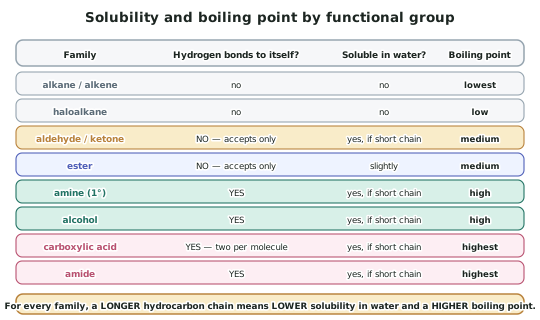
- So for both, the question to ask is: can this molecule hydrogen bond, and how big is its hydrocarbon chain?
Which groups hydrogen bond
-
Hydrogen bond to themselves — these have an O–H or N–H bond:
- alcohols, carboxylic acids, primary amines, amides
-
Cannot hydrogen bond to themselves but CAN accept one from water — these have a lone pair on O or N but no O–H or N–H:
- aldehydes, ketones, esters
-
Cannot do either — no polar group at all:
- alkanes, alkenes, haloalkanes
-
The middle group is the one students get wrong. A ketone is soluble in water despite not hydrogen bonding to itself, because water supplies the hydrogen and the ketone's oxygen supplies the lone pair.
The boiling point order
For molecules of similar size:
-
Alkanes are non-polar — temporary dipole attractions only.
-
Aldehydes, ketones and esters are polar — permanent dipole attractions as well.
-
Alcohols and amines hydrogen bond, so they are higher again.
-
Carboxylic acids are highest, because each molecule has both an O–H to donate and a C=O to accept, so they form two hydrogen bonds to each neighbour.
-
Amides are also very high, for the same reason as acids.
-
Note that alcohols boil higher than amines of similar size, because oxygen is more electronegative than nitrogen, so the O–H hydrogen is more and the hydrogen bonds are stronger.
Chain length changes everything
-
The polar functional group attracts water; the hydrocarbon chain does not.
-
As the chain gets longer:
- solubility in water falls, because the non-polar part becomes a larger fraction of the molecule
- boiling point rises, because there are more electrons and so stronger temporary dipole attractions
-
Compounds with fewer than about five carbons are usually water-soluble if they have a polar group; longer ones are not.
Using these to distinguish compounds
- Distillation separates compounds by boiling point — the lower-boiling one distils off first.
- Solubility separates a carboxylic acid from a neutral compound: adding or converts the acid to its ionic salt, which dissolves in the aqueous layer while the neutral compound stays in the organic layer.
Worked ExampleExplaining a distillation
A student prepares ethyl propanoate by heating propanoic acid and ethanol under reflux with concentrated sulfuric acid. The crude organic layer therefore contains ethyl propanoate together with unreacted propanoic acid and ethanol. Using the boiling points below, explain how distillation can be used to obtain pure ethyl propanoate.
| Compound | Boiling point / °C |
|---|---|
| ethanol | 78.3 |
| ethyl propanoate | 99.1 |
| propanoic acid | 141 |
Step 1 — Explain what distillation separates on
Distillation separates liquids by their boiling points. On heating the mixture, the compound with the lowest boiling point vaporises first, passes into the condenser, cools and is collected, while the higher-boiling compounds remain in the flask.
Step 2 — Account for the order, using intermolecular forces
The three boiling points are very different, and the reason is which attractions each compound forms.
- Ethanol (78.3 °C) has an –OH group so it hydrogen bonds, but it is a small molecule with few electrons, so its temporary dipole attractions are weak. It boils lowest.
- Ethyl propanoate (99.1 °C) is a larger molecule with more electrons, so it has stronger temporary dipole attractions, and it is polar so it also has permanent dipole attractions. But it has no O–H, so its molecules cannot hydrogen bond to each other. It boils in the middle.
- Propanoic acid (141 °C) has an O–H to donate and a C=O to accept, so each molecule forms two hydrogen bonds to a neighbour. These are the strongest attractions of the three, so it boils highest.
Step 3 — Describe what happens on heating
Heat the mixture gently and monitor the temperature at the top of the condenser.
- At around 78 °C the ethanol distils off first. Discard this fraction.
- Raise the temperature. At around 99 °C the ethyl propanoate distils. Collect this fraction — it is the product.
- The propanoic acid, boiling at 141 °C, is left behind in the flask because the temperature never reaches its boiling point.
Step 4 — State why the separation works well here
The three boiling points differ by about 20 °C and 40 °C, which is a large enough gap for the fractions to be collected cleanly.