Triglycerides
A triglyceride is just an ester
- The standard lists ester (including triglycerides) as one of the ten functional groups, and the bracket matters: a triglyceride is not a new family.
- It is an ester — three of them, built on one backbone — so everything you know about esters applies.
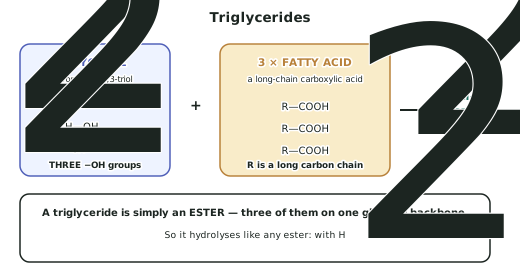
The two building blocks
- Glycerol, systematically propane-1,2,3-triol — a three-carbon chain with an –OH on every carbon:
- Fatty acids — long-chain carboxylic acids, written generally as where R is a long hydrocarbon chain.
Forming the triglyceride
- Each of glycerol's three –OH groups esterifies with one fatty acid, so three ester links form and three molecules of water are lost.
- The three fatty acids need not be the same, and in natural fats they usually are not.
- The product is a triester.
Saturated and unsaturated
-
A saturated fatty acid has no C=C in its chain. Its molecules pack closely, so the triglyceride has a higher melting point and tends to be a solid at room temperature — a fat.
-
An unsaturated fatty acid has one or more C=C, usually cis, which puts a kink in the chain. Kinked chains cannot pack as closely, so the attractions between molecules are weaker, the melting point is lower, and the triglyceride tends to be a liquid — an oil.
-
Unsaturated triglycerides therefore decolourise bromine water; saturated ones do not.
Hydrolysis: making soap
- Because a triglyceride is an ester, it hydrolyses like one.
- With hot aqueous sodium hydroxide the hydrolysis goes to completion, giving glycerol and three carboxylate salts:
- Those long-chain carboxylate salts are soap, and the reaction is traditionally called saponification.
- With acid instead, the hydrolysis gives glycerol and the free fatty acids, and is reversible.
Why soap works
- A soap molecule has two very different ends:
- a long non-polar hydrocarbon tail, which is attracted to grease and oil
- an ionic head, which is attracted to water
- The tail dissolves into a grease droplet while the head stays in the water, so the grease is lifted away and suspended in the water and can be rinsed off.
Worked ExampleHydrolysing a triglyceride
A triglyceride is formed from glycerol and three molecules of octadecanoic acid (stearic acid), , a saturated fatty acid.
(a) Write an equation for the formation of the triglyceride. (b) Write an equation for its hydrolysis with hot aqueous sodium hydroxide, and name the products. (c) A second triglyceride is made from a fatty acid of the same chain length but containing one cis C=C. Predict how its melting point would compare, and give a test that would distinguish the two triglycerides.
Part (a) — formation
Glycerol has three –OH groups, and each esterifies with one fatty acid molecule. Three molecules of water are lost.
The triglyceride is the triester in which all three of glycerol's oxygens are joined to a group.
Part (b) — hydrolysis with hot NaOH
A triglyceride is an ester, so hot aqueous base hydrolyses it. Since there are three ester links, three moles of NaOH are needed:
Part (c) — the unsaturated triglyceride
Predicting the melting point.
The saturated fatty acid chains are straight, so the triglyceride molecules can pack closely together. Close packing means the molecules are near one another over a large part of their surface, so the temporary dipole attractions between them are strong and a high temperature is needed to melt the solid.
The unsaturated chain contains a cis C=C, which puts a kink in it. Kinked chains cannot pack as closely, so the molecules sit further apart on average, the attractions between them are weaker, and less energy is needed to separate them.
A test to distinguish them.
Add bromine water to each.
- The unsaturated triglyceride contains a C=C, so bromine adds across the double bond and the solution changes from orange to colourless.
- The saturated triglyceride has no C=C, so there is no reaction and the solution stays orange.