Addition to alkenes
Why addition is on this course
- The standard is specific: addition reactions of alkenes are included "for the identification of the products of elimination reactions".
- So the point of this page is working backwards. An elimination gives you an alkene; adding something across the double bond gives a product whose structure tells you where the double bond was.
- You will not be asked to predict which way an unsymmetrical reagent adds.
The addition reactions
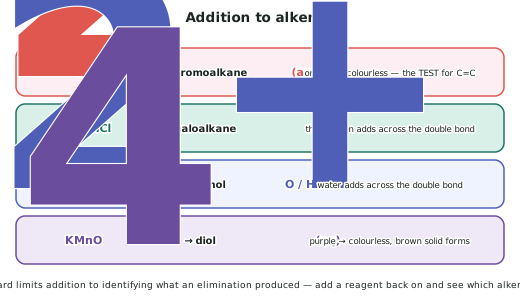
- The double bond opens up and an atom or group adds to each of the two carbons.
| Reagent | Product | What you see |
|---|---|---|
| dibromoalkane | orange → colourless | |
| HBr or HCl | haloalkane | no visible change |
| alcohol | no visible change | |
| , cold and dilute | diol | purple → colourless, brown solid forms |
Bromine water: the test for a C=C
- Adding bromine water to an alkene turns it from orange to colourless.
- This is the standard test for unsaturation — a carbon–carbon double bond.
- An alkane, alcohol or haloalkane gives no change.
- The bromines add to the two carbons that were doubly bonded, and nowhere else. That is what makes the product diagnostic.
Permanganate: a second test
- Cold, dilute potassium permanganate also reacts with a C=C, giving a diol — two –OH groups on adjacent carbons.
- The observation is distinctive: the purple colour disappears and a brown solid () forms.
- Note this is not the same as acidified permanganate, which oxidises alcohols and aldehydes and simply goes colourless.
Identifying an alkene from its addition product
This is the exam application, and the logic is simple:
-
Locate the two carbons that gained the added atoms in the product.
-
The double bond was between those two carbons.
-
Name the alkene accordingly.
-
So a dibromide with bromines on carbons 2 and 3 came from an alkene with its double bond between carbons 2 and 3.
Linking back to elimination
- An elimination from an asymmetric substrate gives two alkenes.
- Treating the mixture with bromine water gives two dibromides, and identifying them tells you which alkenes were present.
- That in turn confirms the major and minor products.
Worked ExampleIdentifying an alkene and its origin
An alkene of molecular formula decolourises bromine water, forming a single product identified as 2,3-dibromopentane.
(a) Identify the alkene. (b) The alkene was made by eliminating water from an alcohol. Give the name and structural formula of two different alcohols that could have produced it, and state which would give the alkene as its major product.
Part (a)
Step 1 — Draw the addition product. 2,3-dibromopentane has a five-carbon chain with bromines on carbons 2 and 3:
Step 2 — Work backwards. In an addition, one bromine adds to each carbon of the double bond. So the two carbons now carrying bromine — C2 and C3 — must be the two that were doubly bonded.
Step 3 — Remove the bromines and restore the double bond.
Part (b)
Step 1 — Work out which carbons must have carried the –OH. Elimination removes the –OH from one carbon and a hydrogen from an adjacent carbon, forming the double bond between them.
The double bond in pent-2-ene is between C2 and C3. So the –OH must have been on either C2 or C3.
Step 2 — Name the two candidate alcohols.
Option 1 — pentan-2-ol:
Option 2 — pentan-3-ol:
Step 3 — Decide which gives pent-2-ene as its major product.
Pentan-3-ol has the –OH on the middle carbon, whose neighbours (C2 and C4) are both groups — identical. Either one gives the same alkene, so pent-2-ene is the only product, not a "major" one.
Pentan-2-ol has the –OH on C2, whose neighbours are C1 (, 3 hydrogens) and C3 (, 2 hydrogens) — different. Two alkenes form, and the major one comes from the carbon with fewer hydrogens, C3 — giving pent-2-ene.