Oxidation of alcohols
The oxidising agents
Only two appear in this standard, and each has its own colour change.
| Reagent | Colour change |
|---|---|
| acidified dichromate, | orange → green |
| acidified permanganate, | purple → colourless |
- The colour change is the observation — quote it whenever you describe a test.
- If no colour change occurs, the alcohol was tertiary.
What each class gives
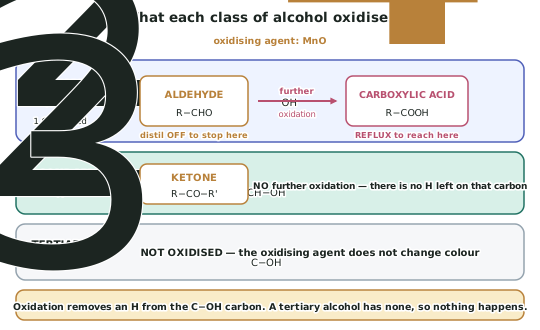
- Primary alcohol → aldehyde → carboxylic acid
- Secondary alcohol → ketone, and no further
- Tertiary alcohol → no reaction
Why the class matters
-
Oxidation replaces a hydrogen on the carbon bearing the –OH.
-
A primary alcohol has two such hydrogens, so it can be oxidised twice — first to an aldehyde, then to a carboxylic acid.
-
A secondary alcohol has one, so it is oxidised once, to a ketone. The ketone has none left, so it stops there.
-
A tertiary alcohol has none, so it cannot be oxidised at all without breaking a carbon–carbon bond.
-
Count the hydrogens on the C–OH carbon and the answer follows immediately.
Stopping at the aldehyde
For a primary alcohol, the conditions decide which product you get.
-
Distil as the reaction proceeds → stop at the aldehyde.
- The aldehyde has a lower boiling point than the alcohol, because it has no O–H and so cannot hydrogen bond to itself.
- It therefore evaporates first and can be removed from the mixture before it is oxidised further.
-
Reflux with excess oxidising agent → go all the way to the carboxylic acid.
- The condenser returns everything to the flask, so the aldehyde stays in contact with the oxidant and is oxidised again.
-
These two words — distil and reflux — are the whole difference. State the one you mean.
Writing the equations
- The oxidising agent is usually shown as [O] in an organic equation, which is accepted at Level 3:
- Note the first step produces water and the second does not.
Worked ExampleDistinguishing three alcohols
Three unlabelled bottles contain butan-1-ol, butan-2-ol and 2-methylpropan-2-ol, all of formula . Describe how you could use chemical tests to identify all three, giving your observations and the structural formula of any organic product formed.
Step 1 — Classify the three alcohols
| Alcohol | Structure | Carbons on the C–OH carbon | Class |
|---|---|---|---|
| butan-1-ol | 1 | primary | |
| butan-2-ol | 2 | secondary | |
| 2-methylpropan-2-ol | 3 | tertiary |
Step 2 — First test: warm each with acidified dichromate
Add acidified potassium dichromate, , to a sample from each bottle and warm.
- butan-1-ol — the solution turns orange to green. It is oxidised.
- butan-2-ol — the solution turns orange to green. It is oxidised.
- 2-methylpropan-2-ol — the solution stays orange. No reaction.
The tertiary alcohol is now identified, because it has no hydrogen on the carbon bearing the –OH and so cannot be oxidised.
Step 3 — Second test: identify the oxidation products
The first test cannot separate the primary from the secondary alcohol, since both turn the dichromate green. So oxidise both under reflux with excess oxidant and test the products.
- butan-1-ol (primary) is oxidised through butanal to the carboxylic acid:
- butan-2-ol (secondary) is oxidised to a ketone and no further:
Step 4 — Distinguish the two products
Add sodium carbonate solution to each oxidation product.
- The product from butan-1-ol is a carboxylic acid, so it fizzes, releasing bubbles of carbon dioxide.
- The product from butan-2-ol is a ketone, which is not acidic, so there is no reaction.