Amines and amides
Two nitrogen families that behave oppositely
-
An amine has nitrogen bonded only to carbon and hydrogen: . It is basic.
-
An amide has nitrogen bonded to a carbonyl carbon: . It is not basic.
-
Both contain an group, so students routinely expect them to behave alike. They do not, and questions exploit that.
Primary amines
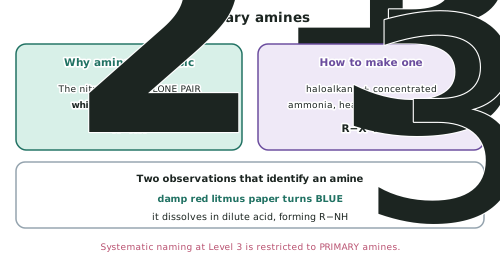
- The 2026 specification restricts systematic naming to primary amines, so you name as propan-1-amine but will not be asked to name a secondary or tertiary one.
Why amines are basic
- The nitrogen of an amine carries a lone pair of electrons.
- That lone pair can accept a proton, which is the definition of a base:
- Two consequences you may be asked for:
- An amine turns damp red litmus paper blue.
- An amine dissolves in dilute acid, forming a soluble alkylammonium salt:
- The salt is ionic, so it is much more soluble in water than the amine was — the same trick that works for carboxylic acids with base, run in reverse.
Making an amine
- Haloalkane + concentrated ammonia, heated in a sealed tube, with the ammonia in excess:
- A primary amine can substitute in place of ammonia, giving a secondary amine.
Amides
- An amide is made from an acyl chloride plus ammonia or a primary amine:
- The second product is an N-substituted amide, and its amide link is the same one that appears in polyamides and proteins.
Why an amide is not basic
-
In an amide the nitrogen sits next to a carbonyl group, and the electronegative carbonyl draws the nitrogen's lone pair towards itself.
-
That lone pair is therefore not available to accept a proton, so an amide is neutral, not basic.
-
An amide does not turn damp red litmus blue, and it does not dissolve in dilute acid the way an amine does.
-
This is the single most useful contrast between the two families, and it is the basis of the test that separates them.
Warming an amide with sodium hydroxide
- An amide is hydrolysed by hot aqueous base, releasing ammonia:
- The ammonia gas turns damp red litmus paper blue when held at the mouth of the tube.
- Note the difference from an amine: the amine itself is basic at room temperature, whereas an amide only produces a base after being hydrolysed by heating with alkali.
Worked ExampleDistinguishing an amine from an amide
Propan-1-amine, , and propanamide, , both contain an group.
(a) Describe a test that distinguishes them at room temperature, giving the observation for each. (b) Explain why they behave differently. (c) Give the equation for the reaction of propanamide with hot aqueous sodium hydroxide, and state what you would observe.
Part (a) — the test
Add a small sample of each to water and test the solution with damp red litmus paper at room temperature.
- Propan-1-amine — the damp red litmus turns blue. It is basic.
- Propanamide — no change; the litmus stays red. It is neutral.
An equally good alternative: add dilute hydrochloric acid to each. The amine dissolves, forming a soluble salt, while the amide does not react.
Part (b) — why they differ
Propan-1-amine is basic. Its nitrogen carries a lone pair of electrons that is freely available, so it can accept a proton:
Accepting a proton from water leaves in solution, which is what turns the litmus blue.
Propanamide is not basic. Its nitrogen is bonded directly to a carbonyl carbon. The electronegative carbonyl group draws the nitrogen's lone pair towards itself, so that lone pair is no longer available to accept a proton.
With no available lone pair the amide cannot act as a base, and the litmus is unaffected.
Part (c) — hydrolysis with hot alkali
Heating propanamide under reflux with aqueous sodium hydroxide hydrolyses it:
Observation: a pungent gas is released which turns damp red litmus paper blue — it is ammonia.
The organic product is sodium propanoate, the salt of propanoic acid, because the strongly basic conditions deprotonate the acid as it forms.