The functional groups
What a functional group is
-
A functional group is the atom or group of atoms in a molecule that determines how it reacts.
-
The rest of the molecule — the carbon chain — is largely a spectator.
-
Two compounds with the same functional group undergo the same reactions, whatever the length of their chains.
-
This is why the whole standard is organised by functional group rather than by compound.
The ten groups you need
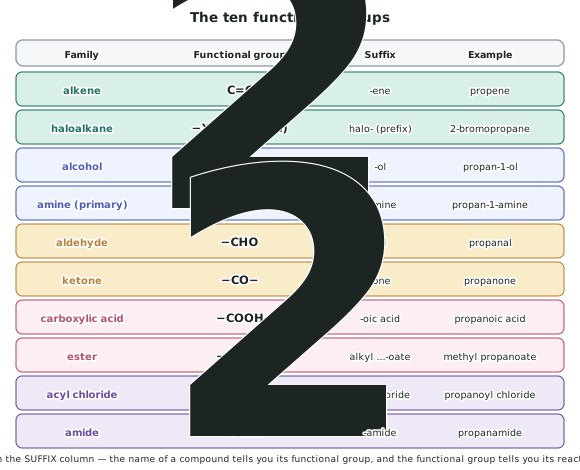
| Family | Group | Suffix | Example |
|---|---|---|---|
| alkene | -ene | propene | |
| haloalkane | (F, Cl, Br, I) | halo- (prefix) | 2-bromopropane |
| alcohol | -ol | propan-1-ol | |
| amine (primary) | -amine | propan-1-amine | |
| aldehyde | -al | propanal | |
| ketone | -one | propanone | |
| carboxylic acid | -oic acid | propanoic acid | |
| ester | alkyl ...-oate | methyl propanoate | |
| acyl chloride | -oyl chloride | propanoyl chloride | |
| amide | -amide | propanamide |
The carbonyl family
-
Six of the ten contain a carbonyl group, . What is attached to that carbon is what distinguishes them:
-
aldehyde — carbonyl carbon has an H and is at the end of the chain
-
ketone — carbonyl carbon has two carbons attached, so it is inside the chain
-
carboxylic acid — carbonyl carbon also carries an –OH
-
ester — carbonyl carbon also carries an –OR
-
acyl chloride — carbonyl carbon also carries a –Cl
-
amide — carbonyl carbon also carries an –NH2 or –NHR
-
Learning the family this way means you only have to look at one carbon to identify six of the ten groups.
Aldehyde or ketone?
- This distinction is asked constantly, and it is purely about position:
- An aldehyde has the carbonyl at the end of the chain, so the carbonyl carbon carries a hydrogen.
- A ketone has the carbonyl within the chain, so the carbonyl carbon carries no hydrogen.
- That missing hydrogen is what makes a ketone resistant to oxidation, so this is not a naming technicality — it drives the chemistry.
Classifying alcohols and haloalkanes
-
Primary (1°) — the functional group carbon is attached to one other carbon.
-
Secondary (2°) — attached to two other carbons.
-
Tertiary (3°) — attached to three other carbons.
-
The class matters enormously for alcohols, because it determines what they oxidise to. Always classify before predicting an oxidation.
Compounds with more than one group
- A molecule may contain several functional groups, and each one reacts independently.
- An amino acid, , has both an amine and a carboxylic acid, and shows the reactions of both.
- When a question gives you a compound with two groups, work through them one at a time.
Worked ExampleIdentifying groups in a multi-functional molecule
Identify every functional group in each of the following, and classify any alcohol or haloalkane you find.
(a) (b) (c)
(a)
Step 1 — Work along the chain from the left. is a plain methyl group, no functional group.
carries an –OH, so there is an alcohol.
is plain.
is a carbonyl carbon carrying a hydrogen at the end of the chain, so it is an aldehyde.
Step 2 — Classify the alcohol. The carbon bearing the –OH is attached to on one side and on the other — two other carbons.
(b)
Step 1 — Find the carbonyl carbon. The in the middle is the key. That carbon has a double-bonded O and a single-bonded O, and that second oxygen is joined to a carbon (), not to a hydrogen.
Step 2 — Decide between acid and ester. If the second oxygen carried an H it would be a carboxylic acid. It carries an ethyl group instead.
(c)
Step 1 — Work along the chain. is an –NH2 attached to a carbon, so there is an amine. It has only one carbon attached to the nitrogen, so it is a primary amine.
carries a chlorine, so there is a haloalkane.
Step 2 — Classify the haloalkane. The carbon bearing the Cl is attached to on one side and on the other — two other carbons.