Reactions of haloalkanes
Two reactions, decided by the solvent
A haloalkane does one of two things depending on what the base is dissolved in. This is the most heavily examined pair of conditions in the standard.
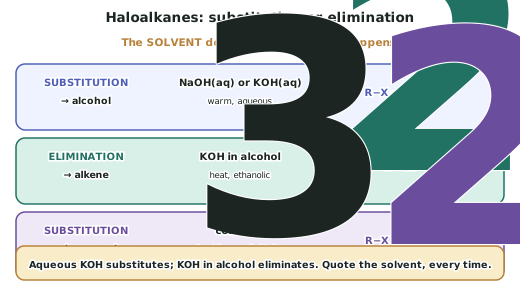
-
or , warmed → substitution → an alcohol
-
KOH dissolved in alcohol, heated → elimination → an alkene
-
Same base, different solvent, completely different product. Quote the solvent every time.
Substitution with hydroxide
- The halogen is replaced by an –OH group.
- Conditions: aqueous sodium or potassium hydroxide, warmed.
- The product is an alcohol, and the halogen leaves as a halide ion in the salt.
Elimination with KOH in alcohol
- A hydrogen and the halogen are removed from adjacent carbons, and a double bond forms between them.
- Conditions: KOH dissolved in ethanol, heated.
- The product is an alkene.
- If the two neighbouring carbons are different, two alkenes form — see the major and minor products page.
Substitution with ammonia
- Concentrated ammonia replaces the halogen with an –NH2 group, giving a primary amine.
- Conditions: concentrated ammonia, heated in a sealed tube, with the ammonia in excess.
- The sealed tube is needed because ammonia is a gas and would otherwise escape on heating.
- Excess ammonia limits further substitution — the amine product can itself react with more haloalkane.
Substitution with a primary amine
- A primary amine can act in place of ammonia, giving a secondary amine.
- You will not be asked to name the secondary amine systematically, but you may be asked to draw it or to identify the reaction type.
Reactivity of the halogens
- The order of reactivity is iodo > bromo > chloro > fluoro.
- The C–I bond is the weakest and the C–F bond the strongest, so the iodoalkane reacts fastest and the fluoroalkane is essentially unreactive.
Worked ExamplePredicting products from the same starting material
Give the structural formula and name of the organic product formed when 2-bromopropane, , is treated with each of the following.
(a) , warmed (b) KOH dissolved in ethanol, heated (c) concentrated , heated in a sealed tube
(a) , warmed
Step 1 — Identify the reaction type. The hydroxide is aqueous, so this is a substitution.
Step 2 — Make the substitution. The bromine is replaced by an –OH, in the same position on the chain.
(b) KOH in ethanol, heated
Step 1 — Identify the reaction type. The KOH is dissolved in alcohol, so this is an elimination.
Step 2 — Find the carbons that lose the atoms. The bromine is on carbon 2. A hydrogen must be removed from a neighbouring carbon — either carbon 1 or carbon 3.
Step 3 — Check whether the two choices give different products. Carbon 1 and carbon 3 are both groups — they are identical. So it makes no difference which one loses a hydrogen: the same alkene results either way.
(c) Concentrated , heated in a sealed tube
Step 1 — Identify the reaction type. Ammonia is a substituting reagent, replacing the halogen.
Step 2 — Make the substitution. The bromine is replaced by an –NH2 group, again on carbon 2.