Cis–trans (geometric) isomers
Stereoisomers
-
Stereoisomers have the same structural formula — the atoms are joined in the same order — but a different arrangement in space.
-
There are two kinds at Level 3: cis–trans isomers, covered here, and enantiomers, covered on the next page.
-
Contrast this with constitutional isomers, where the order of bonding itself is different.
What cis–trans isomerism needs
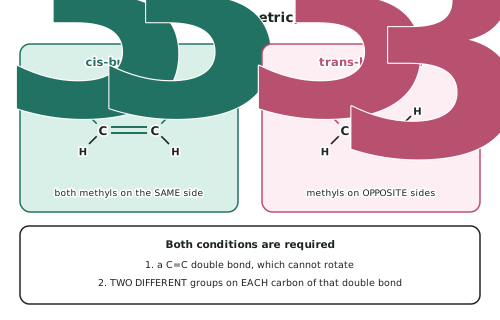
Both conditions must be met:
-
There must be a double bond, because a double bond cannot rotate.
-
Each carbon of the double bond must carry two different groups.
-
If either condition fails, there are no cis–trans isomers.
Why the double bond matters
-
Groups joined by a single bond can rotate freely, so any two arrangements are just the same molecule turning — not different compounds.
-
A double bond is rigid. The groups on either side are locked in position, so two genuinely different compounds exist.
-
This is why but-2-ene has cis and trans forms but butane does not.
Naming them
-
cis — the two similar or higher-priority groups are on the same side of the double bond.
-
trans — they are on opposite sides.
-
exists as cis-but-2-ene and trans-but-2-ene.
Testing a structure
-
Find the . No double bond, no cis–trans isomerism.
-
Look at the left-hand carbon. Are its two groups different from each other?
-
Look at the right-hand carbon. Are its two groups different from each other?
-
Both must be yes.
-
(but-1-ene) has no cis–trans isomers, because the left carbon carries two hydrogens — two identical groups.
-
has no cis–trans isomers either, because the left carbon carries two methyl groups.
How they differ in properties
- Cis and trans isomers are different compounds with different physical properties — different melting points, boiling points and densities.
- The cis isomer is usually the more polar, because its bond dipoles are on the same side and do not cancel; the trans isomer is often symmetrical enough for them to cancel.
- Their chemical reactions are largely the same, because they have the same functional group.
Worked ExampleDeciding which compounds show cis–trans isomerism
For each compound, state whether it can exist as cis–trans isomers, and justify your answer. Where isomers exist, draw them.
(a) (b) (c)
(a)
Step 1 — Is there a ? Yes, between carbons 2 and 3.
Step 2 — Check the left-hand carbon of the double bond. It carries a and an H — two different groups. ✓
Step 3 — Check the right-hand carbon. It carries a Cl and an H — two different groups. ✓
Both conditions are met.
(b)
Step 1 — Is there a ? Yes, between carbons 1 and 2.
Step 2 — Check the left-hand carbon. It is a , so it carries two hydrogens — the same group twice. ✗
Step 3 — Conclude. The second condition fails immediately, so there is no need to check the other carbon. Swapping the two hydrogens produces an identical molecule.
(c)
Step 1 — Is there a ? No. Every carbon–carbon bond in this molecule is a single bond.
Single bonds rotate freely, so any two arrangements of the groups are simply the same molecule in a different orientation.