Carboxylic acids and their derivatives
The family
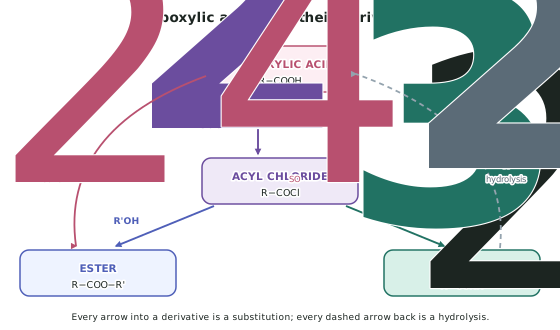
- A carboxylic acid, , has three derivatives in this standard: the acyl chloride, the ester and the amide.
- All four have a carbonyl carbon bonded to a second atom, and that atom is what names the family.
Carboxylic acids are acidic
-
The O–H of the group is polar enough for the hydrogen to be released as , so carboxylic acids are weak acids.
-
They show all the usual acid reactions.
-
With sodium carbonate — the standard test:
-
The observation is bubbles of carbon dioxide. No other family on this course fizzes with carbonate.
-
With sodium hydroxide — a neutralisation giving a salt and water:
- The salt is ionic, so it is far more soluble in water than the acid was. This is the basis of separating an acid from a neutral compound.
Making an acyl chloride
- Thionyl chloride, , replaces the acid's –OH with a –Cl:
- Both by-products are gases, so they escape and the reaction goes to completion.
- Note that does the same job on an alcohol, giving a haloalkane — in both cases it swaps an –OH for a Cl.
Acyl chlorides are the reactive one
An acyl chloride reacts readily with anything carrying an –OH or an –NH group.
| Reagent | Product | Also formed |
|---|---|---|
| water | carboxylic acid | HCl — steamy fumes |
| an alcohol | ester | HCl |
| conc | amide | HCl |
| a primary amine | N-substituted amide | HCl |
-
-
-
-
The reaction with water is the test for an acyl chloride. Adding a few drops of water produces steamy fumes of hydrogen chloride immediately, at room temperature.
Two routes to an ester
-
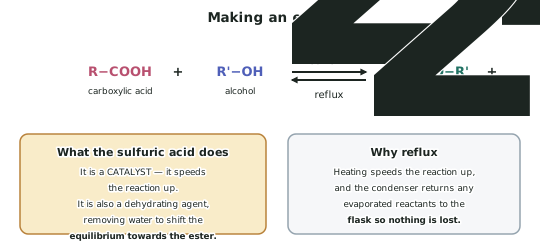
From the acid: acid + alcohol, catalysed by concentrated , refluxed. Reversible, so the yield is limited.
-
From the acyl chloride: acyl chloride + alcohol. Not reversible, and it happens at room temperature, so the yield is much better.
-
If a question asks for the better route to an ester, the acyl chloride route is the answer — at the cost of one extra step.
Worked ExampleChoosing and justifying a synthetic route
A chemist needs to prepare ethyl propanoate from propanoic acid in as high a yield as possible.
(a) Give the equation and conditions for the direct esterification. (b) Give a two-step route via an acyl chloride, with equations. (c) Justify which route gives the higher yield.
Part (a) — the direct route
Propanoic acid reacts with ethanol, catalysed by concentrated sulfuric acid, heated under reflux:
Note the equilibrium arrows — this is the key feature of the route.
Part (b) — the two-step route
Step 1 — make the acyl chloride using thionyl chloride:
Both by-products are gases and escape, so this step goes essentially to completion.
Step 2 — react the acyl chloride with ethanol, at room temperature:
Note the single arrow — this reaction is not reversible.
Part (c) — justifying the choice
The direct route is limited by equilibrium. Esterification is reversible: as the ester and water build up, the reverse reaction (hydrolysis of the ester) becomes significant, and the mixture settles at an equilibrium position containing substantial amounts of unreacted acid and alcohol.
Even with the sulfuric acid absorbing some of the water, the yield is typically only around 60–70 %, and the product must be separated from the leftover reactants.
The acyl chloride route goes to completion.
- Step 1 is driven forward because and HCl are gases that leave the reaction mixture, so they cannot react back.
- Step 2 is not an equilibrium — the acyl chloride is far more reactive than the acid, and the reaction proceeds to completion at room temperature.
With no equilibrium limiting either step, the overall yield is considerably higher.