Polyesters, polyamides and proteins
Condensation polymerisation
-
A condensation polymerisation joins many monomers into a long chain, losing a small molecule at every link.
-
The small molecule is usually water, or HCl if an acyl chloride is used.
-
The standard covers exactly two kinds: polyesters and polyamides, including proteins.
-
Contrast this with the addition polymerisation of alkenes met at Level 2, where nothing is lost.
Every monomer needs two functional groups
-
To build a chain, each monomer must be able to bond at both ends.
-
A difunctional monomer keeps the chain growing; a monomer with only one functional group stops it.
-
So polyesters need a diol and a dicarboxylic acid, and polyamides need a diamine and a dicarboxylic acid.
-
Alternatively, a single monomer carrying both groups can polymerise with itself. Lactic acid, which has an –OH and a –COOH, polymerises to polylactic acid.
Polyesters
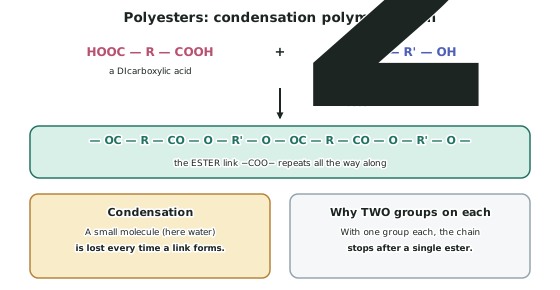
- Dicarboxylic acid + diol → polyester + water
- The link formed is an ester link, .
Polyamides
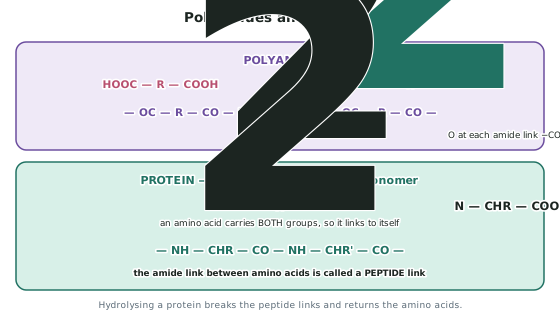
- Dicarboxylic acid + diamine → polyamide + water
- The link formed is an amide link, .
Proteins
-
An amino acid has the general structure — it carries both an amine group and a carboxylic acid group.
-
Because it has both, it can condense with itself, and many amino acids link into a protein.
-
The amide link between two amino acids is given a special name: the peptide link.
-
Two amino acids give a dipeptide; many give a polypeptide or protein.
-
The 2026 specification states you are not expected to recall the common names of amino acids — a structure will always be supplied.
Drawing a repeat unit
-
Identify the two functional groups that will react.
-
Remove the small molecule — take –OH from the acid and –H from the alcohol or amine.
-
Join what remains to make the ester or amide link.
-
Draw at least two or three units so the repeating pattern is visible, with a bond continuing at each end.
-
Leaving off the continuation bonds is a common way to lose the mark, because it draws a discrete molecule rather than a polymer.
Hydrolysing a polymer
- Both polyesters and polyamides can be hydrolysed back to their monomers, because the links are ordinary ester and amide groups.
- Hydrolysing a protein breaks all the peptide links and releases the individual amino acids.
- In acid the amino acids appear with their protonated; in base with their deprotonated.
Worked ExampleBuilding a polyester and explaining a failure
(a) Lactic acid, , polymerises to poly(lactic acid). Draw a section of the chain showing three repeating units, and identify the type of reaction.
(b) Explain why ethanoic acid, , cannot form a polymer, and explain what would happen if a small amount of ethanoic acid were added to a polymerising mixture of a diol and a dicarboxylic acid.
Part (a)
Step 1 — Identify the two reacting groups. Lactic acid carries both an –OH and a –COOH on the same molecule. That is what allows it to react with itself.
Step 2 — Form one link. The –OH of one molecule reacts with the –COOH of the next, losing a molecule of water and forming an ester link, .
Step 3 — Repeat and draw three units.
Note the bonds continuing at both ends, showing the chain carries on.
Step 4 — Name the reaction type.
Part (b)
Step 1 — Count the functional groups in ethanoic acid. has one functional group — a single –COOH. The rest of the molecule is an unreactive methyl group.
Step 2 — Explain why one group is not enough. Polymerisation requires each monomer to bond at both ends so the chain can keep growing.
Ethanoic acid can form one ester link through its –COOH, but once that link is made the molecule has nothing left to react with. The chain cannot continue past it.
Step 3 — Explain the effect of adding it to a polymerisation. If ethanoic acid is added to a mixture of a diol and a dicarboxylic acid, it will compete with the dicarboxylic acid for the –OH groups of the diol.
Wherever an ethanoic acid molecule reacts with the end of a growing chain, it forms an ester link and then caps that end — the chain can no longer grow in that direction because the methyl group is unreactive.
Consequence: the polymer chains are terminated early, so the average chain length is much shorter and the polymer's molar mass is lower.