Hydrolysis of esters and amides
What hydrolysis is
-
Hydrolysis is splitting a molecule apart using water.
-
An ester hydrolyses back to the carboxylic acid and the alcohol it was made from.
-
An amide hydrolyses back to the carboxylic acid and the amine (or ammonia).
-
It is the reverse of the reaction that made them, which is why it always regenerates the two original halves.
Four cases to know
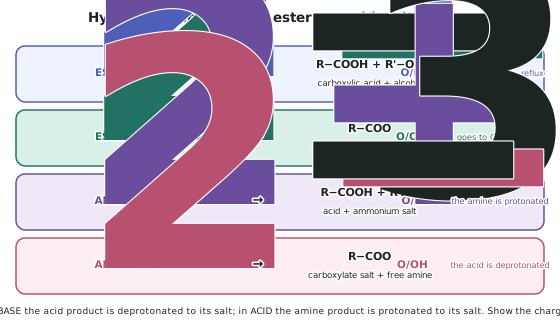
| Starting material | Conditions | Products |
|---|---|---|
| ester | , reflux | carboxylic acid + alcohol — reversible |
| ester | , reflux | carboxylate salt + alcohol — complete |
| amide | , reflux | carboxylic acid + ammonium salt |
| amide | , reflux | carboxylate salt + free amine |
- All four need heating under reflux. Hydrolysis is slow at room temperature.
The rule that ties them together
Whichever product could react with the conditions, does.
-
In acid conditions, a basic product — an amine — is protonated to its salt: .
-
In basic conditions, an acidic product — a carboxylic acid — is deprotonated to its salt: .
-
So you never get a free acid in base, and you never get a free amine in acid. Show the charges.
Ester hydrolysis in detail
In acid — the exact reverse of esterification, so it is reversible:
In base — the carboxylate salt forms, and the reaction goes to completion:
-
Why base hydrolysis goes to completion: the acid product is immediately converted to its carboxylate salt, which cannot react back with the alcohol. Removing a product this way drives the reaction forward.
-
To obtain the free acid afterwards, acidify the mixture with dilute HCl.
-
Base hydrolysis of an ester is therefore the preferred method when you want a complete conversion.
Amide hydrolysis in detail
In acid:
- The ammonia or amine is released as its ammonium salt, because the acidic conditions protonate it.
In base:
-
The free ammonia is released, and can be detected as a pungent gas turning damp red litmus blue.
-
The acid appears as its carboxylate salt.
-
Amides are harder to hydrolyse than esters and need more vigorous conditions — prolonged reflux with concentrated acid or alkali.
Worked ExampleHydrolysing a dipeptide two ways
A dipeptide has the structure below, in which two amino acid units are joined by an amide (peptide) link.
Draw the organic products formed when the dipeptide is heated under reflux with
(a) dilute hydrochloric acid, (b) aqueous sodium hydroxide.
Step 1 — Locate the bond that breaks
The amide (peptide) link is the in the middle. Hydrolysis breaks the bond between the carbonyl carbon and the nitrogen.
The carbonyl carbon stays with the left-hand fragment, and the nitrogen goes with the right-hand one.
Splitting there and adding the elements of water gives the two amino acids:
- from the left:
- from the right:
These are the neutral forms. Now apply the conditions.
Step 2 — Part (a), hydrolysis in acid
In acidic conditions any basic group is protonated. Each fragment carries an group, which is basic, so both are protonated to .
The groups are not affected — the conditions are already acidic.
Step 3 — Part (b), hydrolysis in base
In basic conditions any acidic group is deprotonated. Each fragment carries a group, which is acidic, so both are deprotonated to .
The groups are not protonated — there is no acid present to do it.