Enantiomers (optical isomers)
What enantiomers are
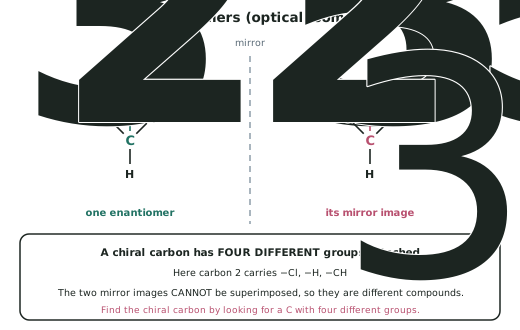
- Enantiomers, also called optical isomers, are non-superimposable mirror images of each other.
- They are a kind of stereoisomer: the atoms are joined in the same order, but arranged differently in space.
- Like your left and right hands, they look identical but cannot be laid on top of one another.
The one requirement: a chiral carbon
-
A chiral carbon is a carbon atom with four different groups attached to it.
-
A molecule containing a chiral carbon exists as two enantiomers.
-
It is also called an asymmetric carbon or a chiral centre. All three terms are accepted.
-
To find one, look at each carbon in turn and ask: are all four things attached to it different?
Worked identification
For 2-chlorobutane, , check each carbon:
-
C1 () — carries three hydrogens. Not chiral.
-
C2 () — carries two hydrogens. Not chiral.
-
C3 () — carries , , and . All four different — chiral. ✓
-
C4 () — three hydrogens. Not chiral.
-
So 2-chlorobutane exists as two enantiomers.
Rotation of plane-polarised light
This is the property the standard names, and it is the only way to tell enantiomers apart.
-
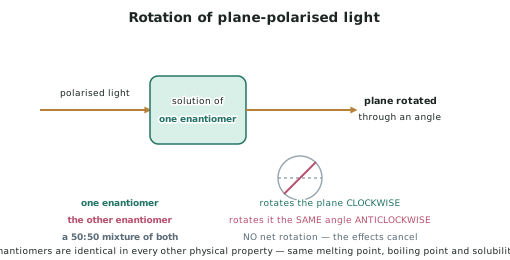
Plane-polarised light vibrates in a single plane.
-
A solution of one enantiomer rotates that plane through an angle.
-
The other enantiomer rotates it through the same angle in the opposite direction.
-
A 50:50 mixture of the two — a racemic mixture — produces no net rotation, because the two effects cancel exactly.
-
This is why enantiomers are described as optically active, and why the isomerism is called optical.
Everything else about them is identical
-
Enantiomers have the same melting point, the same boiling point, the same solubility and the same density.
-
They undergo the same chemical reactions with ordinary reagents, because they have the same functional groups.
-
The only ordinary difference is the direction in which they rotate plane-polarised light.
-
This makes them very hard to separate, and it is why the rotation measurement matters.
Worked ExampleFinding the chiral carbon and explaining the consequence
(a) 2-hydroxypropanoic acid (lactic acid), , exists as enantiomers. Identify the chiral carbon and explain why the molecule is chiral. (b) Explain why 2-hydroxy-2-methylpropanoic acid, , does not exist as enantiomers.
(a) Lactic acid
Step 1 — Eliminate the carbons that cannot be chiral.
- C1 is the carbon. It is bonded to only three things — a double-bonded O, an –OH and a carbon — so it cannot carry four different groups.
- C3 is a , carrying three identical hydrogens. Not chiral.
That leaves only C2 to examine.
Step 2 — List the four groups on C2.
| Position | Group |
|---|---|
| 1 | |
| 2 | |
| 3 | |
| 4 |
Step 3 — Check they are all different. A hydrogen, a hydroxyl group, a methyl group and a carboxylic acid group — all four are different. ✓
Step 4 — State the consequence. Because C2 carries four different groups, it is a chiral carbon. The molecule and its mirror image cannot be superimposed on one another, so they are different compounds.
(b) 2-hydroxy-2-methylpropanoic acid
Step 1 — Identify the only candidate carbon. Again the carbon has only three attachments, and the two groups each carry three hydrogens. So only the central carbon could be chiral.
Step 2 — List its four groups.
| Position | Group |
|---|---|
| 1 | |
| 2 | |
| 3 | |
| 4 |
Step 3 — Spot the repeat. Two of the four groups are both methyl groups — they are identical.
Step 4 — Explain the consequence. With two identical groups on the central carbon, swapping them produces the same molecule. The mirror image can be rotated so that it lies exactly on top of the original, so the two are superimposable.