Constitutional isomers
The definition
-
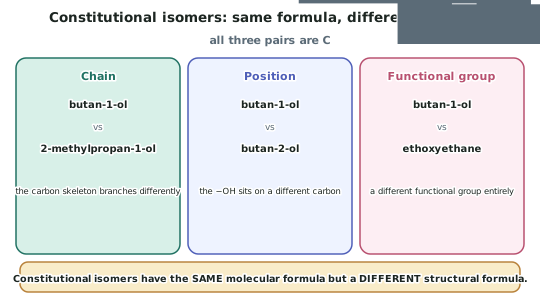
Constitutional isomers are compounds with the same molecular formula but a different structural formula.
-
That is the definition given in the assessment specification, and it is worth quoting exactly.
-
They are different compounds with different properties — not different drawings of the same thing.
-
Constitutional isomers are also called structural isomers. Both names are accepted.
The three ways structures can differ
-
Chain isomers — the carbon skeleton branches differently.
- butan-1-ol, , and 2-methylpropan-1-ol,
-
Position isomers — the functional group is on a different carbon.
- butan-1-ol and butan-2-ol,
-
Functional group isomers — a completely different functional group.
- propanal, , and propanone, — both
-
All three types count as constitutional isomers. A question asking for "three constitutional isomers" will accept any mixture of them.
Finding isomers systematically
Guessing produces duplicates. Work through in order:
- Draw the longest straight chain first, and move the functional group along it one carbon at a time.
- Shorten the chain by one carbon and add the removed carbon as a branch, then move the functional group again.
- Repeat until no shorter chain is possible.
- Check each structure against the others — rotating a molecule does not make a new isomer.
Isomer pairs that come up repeatedly
| Molecular formula | One isomer | Another |
|---|---|---|
| propanal (aldehyde) | propanone (ketone) | |
| ethanoic acid (acid) | methyl methanoate (ester) | |
| ethanol (alcohol) | methoxymethane (ether) | |
| propan-1-amine | propan-2-amine |
- The aldehyde/ketone and acid/ester pairs matter most, because they behave completely differently in the chemical tests.
Why the same formula can behave differently
- Two isomers have the same atoms but a different arrangement, so they have different functional groups or different shapes.
- Because the functional group controls the chemistry, isomers can react completely differently:
- propanal gives a silver mirror with Tollens'; propanone gives no reaction.
- ethanoic acid fizzes with sodium carbonate; methyl methanoate does not.
- Their physical properties differ too — different boiling points, different solubilities — because different groups mean different intermolecular attractions.
Worked ExampleFinding isomers to a specification
Draw the structural formulae of three constitutional isomers of that each contain a carbonyl group (), and name each one.
Step 1 — Work out what the constraint allows
has four carbons and one oxygen, and the oxygen must be in a carbonyl group.
A carbonyl compound with no other functional group is either an aldehyde (carbonyl at the end of the chain) or a ketone (carbonyl within it). So we are looking for four-carbon aldehydes and ketones.
Step 2 — Take the straight chain first
With all four carbons in one chain:
- Carbonyl at carbon 1 — an aldehyde:
- Carbonyl at carbon 2 — a ketone:
- Carbonyl at carbon 3 would be the same molecule as carbon 2 viewed from the other end, so it is not a new isomer.
Step 3 — Shorten the chain and branch it
Use a three-carbon chain with the fourth carbon as a methyl branch.
For the carbonyl to be at the end (an aldehyde) with a methyl on carbon 2:
A branched ketone is not possible with only four carbons — the carbonyl carbon would need two carbons attached plus a branch, which requires at least five.
Step 4 — Check every structure against the formula
| Structure | C | H | O |
|---|---|---|---|
| 4 | 8 | 1 ✓ | |
| 4 | 8 | 1 ✓ | |
| 4 | 8 | 1 ✓ |