Distinguishing between organic compounds
What these questions look like
- You are given several compounds and a set of observations, and must match them up.
- Or you are given two or three compounds and asked to devise tests that tell them apart.
- Either way the marks are for the observation, not just the name of the reagent.
The complete test table
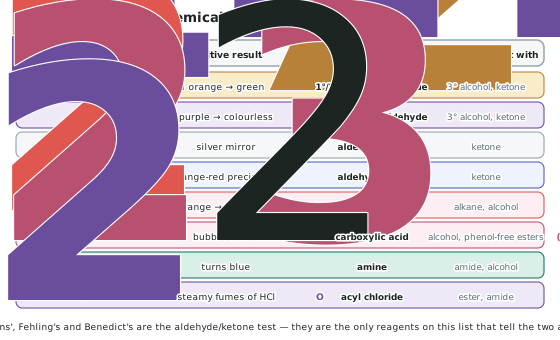
| Reagent | Positive observation | Reacts with | Does not react with |
|---|---|---|---|
| orange → colourless | alkene | alkane, alcohol, carbonyl | |
| bubbles of | carboxylic acid | alcohol, ester, aldehyde | |
| water | steamy fumes of HCl | acyl chloride | ester, amide |
| damp red litmus | turns blue | amine | amide, alcohol |
| Tollens' | silver mirror | aldehyde | ketone, alcohol |
| Fehling's / Benedict's | orange-red precipitate | aldehyde | ketone, alcohol |
| orange → green | 1°/2° alcohol, aldehyde | 3° alcohol, ketone | |
| purple → colourless | 1°/2° alcohol, aldehyde | 3° alcohol, ketone |
Choosing the right test
-
Some tests are specific — only one family responds. Use these first:
- carbonate → acid, water → acyl chloride, litmus → amine, bromine water → alkene
-
Others respond to more than one family, so they need a follow-up:
- dichromate goes green with a primary alcohol, a secondary alcohol and an aldehyde
- Tollens' then separates the aldehyde from the alcohols
-
So the standard strategy is: use a specific test if one exists; otherwise use two tests in sequence.
Distinguishing a primary alcohol from an aldehyde
This pair comes up constantly, because both turn dichromate green.
- Tollens' reagent separates them: the aldehyde gives a silver mirror, the alcohol gives no change.
- The reason is that Tollens' is a mild oxidising agent — strong enough to oxidise an aldehyde but not an alcohol.
Distinguishing a carboxylic acid from an acyl chloride
- Both eventually fizz with carbonate, because the acyl chloride hydrolyses in the aqueous solution to the acid first.
- So test with water alone: the acyl chloride gives steamy fumes, the acid does not.
- Do the water test first, then the carbonate test.
Writing a good answer
- Name the reagent precisely — "acidified potassium dichromate", not "dichromate".
- Give the observation for the positive case and for the negative one.
- If a colour change, give both colours.
- If a gas, say what it is and how you would identify it.
Worked ExampleMatching compounds to observations
Six compounds are listed below.
| Compound | |
|---|---|
| 1 | |
| 2 | |
| 3 | |
| 4 | |
| 5 | |
| 6 |
Match each set of observations to the correct compound number, and justify each choice.
- (a) Adding a few drops of water produces steamy fumes.
- (b) Adding sodium carbonate solution produces bubbles of gas.
- (c) Warming with Tollens' reagent gives a silver mirror.
- (d) Bromine water changes from orange to colourless; acidified dichromate stays orange.
- (e) Acidified dichromate turns from orange to green; Tollens' gives no change.
- (f) No reaction with any of the above reagents.
Step 1 — Identify the functional group in each compound
| Compound | Functional group | |
|---|---|---|
| 1 | primary alcohol (butan-1-ol) | |
| 2 | aldehyde (butanal) | |
| 3 | ketone (butanone) | |
| 4 | carboxylic acid (butanoic acid) | |
| 5 | acyl chloride (propanoyl chloride) | |
| 6 | alkene (but-1-ene) |
Step 2 — Work through the specific tests first
(a) Steamy fumes with water → Compound 5. Only an acyl chloride is hydrolysed by water at room temperature, releasing hydrogen chloride gas:
(b) Bubbles with sodium carbonate → Compound 4. Only a carboxylic acid is acidic enough to release carbon dioxide from a carbonate:
(Compound 5 would also fizz once hydrolysed, which is why test (a) is done separately and first.)
(c) Silver mirror with Tollens' → Compound 2. Only an aldehyde has a hydrogen on its carbonyl carbon, allowing the mild oxidant to oxidise it while the silver(I) ions are reduced to silver metal.
(d) Bromine water decolourised, dichromate unchanged → Compound 6. Decolourising bromine water indicates a C=C double bond. The dichromate staying orange rules out an alcohol or aldehyde, confirming the compound is a hydrocarbon alkene with no other oxidisable group.
Step 3 — Use the two-test sequence for the remaining pair
Compounds 1 and 3 are left, matched to observations (e) and (f).
(e) Dichromate orange → green, but no silver mirror → Compound 1. Butan-1-ol is a primary alcohol, so it is oxidised by acidified dichromate and the solution turns green.
But Tollens' is a much milder oxidising agent and is not strong enough to oxidise an alcohol, so there is no silver mirror.
That combination — green with dichromate, nothing with Tollens' — is what distinguishes a primary alcohol from an aldehyde, since an aldehyde would give both.
(f) No reaction with anything → Compound 3. Butanone is a ketone:
- not oxidised by dichromate, because its carbonyl carbon has no hydrogen → stays orange
- no silver mirror with Tollens', for the same reason
- not acidic, so no fizzing with carbonate
- no C=C, so bromine water stays orange
- no acyl chloride, so no steamy fumes