Molecular, condensed and structural formulae
Three ways of writing the same molecule
The standard asks you to name and/or draw structural formulae, so you must be able to move between the three ways of writing a compound.
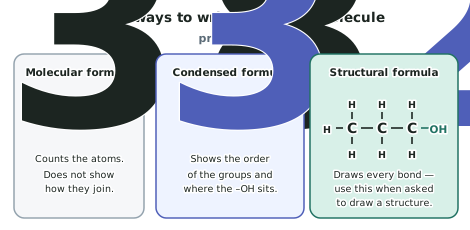
- Molecular formula — counts the atoms of each element. .
- Fast to write, but it does not tell you how the atoms are joined, so it cannot distinguish isomers.
- Condensed formula — shows the order of the groups along the chain. .
- This is what you write in equations. It shows where the functional group sits.
- Structural formula — every atom and every bond drawn as a line.
- This is what "draw the structural formula" means in an exam.
How to draw a structural formula
- Draw the carbon skeleton first — the longest chain, as a horizontal row of C's joined by lines.
- Add the functional group to the correct carbon, counted from the correct end.
- Add hydrogens until every carbon has exactly four bonds.
- Check every atom: carbon 4 bonds, oxygen 2, nitrogen 3, hydrogen and halogens 1.
Worked through for propan-2-ol:
- Three carbons: C–C–C.
- The –OH goes on carbon 2, the middle one.
- Carbon 1 needs 3 H, carbon 2 already has C, C and OH so it needs 1 H, carbon 3 needs 3 H.
- Final check: each carbon has four bonds. ✓
The valency check that catches most errors
Every atom has a fixed number of bonds it must make:
| Atom | Bonds |
|---|---|
| Carbon (C) | 4 |
| Nitrogen (N) | 3 |
| Oxygen (O) | 2 |
| Hydrogen (H) | 1 |
| Halogen (F, Cl, Br, I) | 1 |
- A double bond counts as two of a carbon's four bonds; a triple bond counts as three.
- If a carbon in your drawing has three or five bonds, the structure is wrong — go back and count.
Reading a condensed formula
- Brackets show a group hanging off the carbon just before them.
- — the is a branch on the middle carbon.
- — the –OH is on the middle carbon; this is propan-2-ol.
- A subscript after a bracket means that group is repeated.
- — three methyl groups on the carbon that carries the –OH.
- = shows a double bond between the carbons either side of it.
- — the double bond is between carbons 2 and 3 as written, which is carbon 1 and 2 once numbered from the nearer end.
Worked ExampleDrawing a structure from a name
Draw the structural formula of 2-bromobutane and give its molecular formula.
Step 1 — Read the stem
"But-" means the longest chain is 4 carbons, and "-ane" means all single bonds.
Draw the skeleton: C–C–C–C
Step 2 — Place the substituent
"2-bromo" means a bromine atom on carbon 2. Number from the left so the Br lands on the second carbon, and attach it there.
Step 3 — Fill in the hydrogens
Give every carbon four bonds in total:
- Carbon 1 — one bond to C2, so 3 H.
- Carbon 2 — bonds to C1, C3 and Br, so 1 H.
- Carbon 3 — bonds to C2 and C4, so 2 H.
- Carbon 4 — one bond to C3, so 3 H.
The condensed form of what you have drawn is .
Step 4 — Count the atoms for the molecular formula
Carbons: . Hydrogens: . Bromines: 1.