Substitution reactions of alcohols
Swapping the –OH for a halogen
- In a substitution reaction, the –OH group is replaced by a halogen atom, turning the alcohol into a haloalkane.
- This is one of the two main things an alcohol can do (the other being oxidation), and it is the route alcohol → haloalkane on the reaction map.
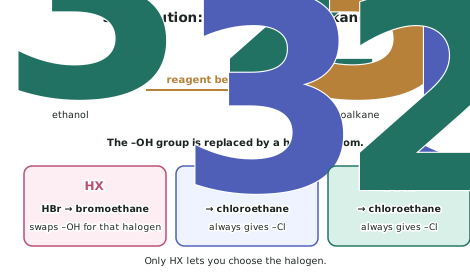
The four reagents
| Reagent | Product | Note |
|---|---|---|
| (HCl, HBr, HI) | the matching haloalkane | the only reagent that lets you choose the halogen |
| a chloroalkane | always gives –Cl | |
| a chloroalkane | always gives –Cl | |
| a chloroalkane | always gives –Cl |
- Three of the four reagents contain chlorine only, so they can only make chloroalkanes.
- If a question asks you to make a bromoalkane or an iodoalkane from an alcohol, the reagent must be HBr or HI.
With a hydrogen halide
- The –OH is replaced by –Br, and the second product is water.
- The halogen ends up on the same carbon the –OH was on. The skeleton does not change.
With the chlorinating reagents
- The organic product is the chloroalkane — that is what a question is asking for.
- The inorganic by-products differ between , and , and you are not expected to reproduce them.
Working out the product
- Find the carbon carrying the –OH.
- Replace the whole –OH group with the halogen atom — on that same carbon.
- Leave the rest of the molecule alone.
- Name the product as a haloalkane, using the same locant the alcohol had.
Worked through:
- propan-2-ol + HBr → the –OH on carbon 2 becomes –Br on carbon 2 → 2-bromopropane.
- butan-1-ol + → –OH on carbon 1 becomes –Cl on carbon 1 → 1-chlorobutane.
Substitution compared with the other reaction types
| What happens | Products | |
|---|---|---|
| Substitution | one group swapped for another | organic product + a second product |
| Addition | a double bond opens, atoms add on | one product only |
| Elimination | a small molecule is removed, a double bond forms | organic product + the small molecule |
Worked ExampleChoosing the right reagent
A chemist has a sample of butan-2-ol. Describe how it could be converted into (a) 2-chlorobutane and (b) 2-bromobutane, giving a reagent and an equation for each.
Step 1 — Identify what has to change
Butan-2-ol is — the –OH is on carbon 2.
Both targets are haloalkanes with the halogen on carbon 2, so in each case the –OH must be substituted by a halogen atom, on the same carbon. The carbon skeleton does not change.
Step 2 — (a) Making the chloroalkane
Any of the chlorinating reagents will do this: , , — or HCl.
Using :
The organic product is 2-chlorobutane.
Step 3 — (b) Making the bromoalkane
Here the choice is restricted. , and all contain chlorine only, so none of them can make a bromoalkane. The reagent must be a hydrogen halide containing bromine: HBr.
The organic product is 2-bromobutane, and the second product is water.