Oxidation of alcohols
The oxidising agents
Two are used, and you need both:
-
Acidified permanganate, — usually potassium permanganate with dilute sulfuric acid.
-
Acidified dichromate, — usually potassium dichromate with dilute sulfuric acid.
-
Both are warmed with the alcohol.
-
Each has its own colour change, and you must quote the right one for the reagent named in the question.
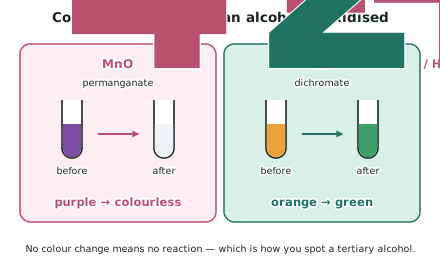
| Oxidising agent | Colour before | Colour after |
|---|---|---|
| purple | colourless | |
| orange | green |
What forms depends on the classification
This is the whole of the topic in three lines:
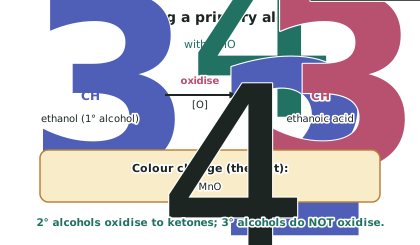
- Primary (1°) alcohol → carboxylic acid
- Secondary (2°) alcohol → ketone
- Tertiary (3°) alcohol → no reaction
Primary alcohols
- A primary alcohol is oxidised all the way to a carboxylic acid.
- Ethanol → ethanoic acid. This is what happens to wine left open — it goes sour.
- The number of carbons does not change: the –OH carbon becomes the –COOH carbon.
- butan-1-ol → butanoic acid (still four carbons).
Secondary alcohols
- A secondary alcohol is oxidised to a ketone.
- The –OH carbon keeps its two carbon neighbours and gains a double-bonded oxygen.
- You are not required to name ketones in this standard — recognising the product is a ketone is enough.
Tertiary alcohols
- A tertiary alcohol is not oxidised at all.
- Its –OH carbon is bonded to three carbons, so there is no hydrogen on that carbon to remove, and oxidation of an alcohol requires one.
- The colour does not change — the permanganate stays purple, the dichromate stays orange.
- This "no reaction" is genuinely useful: it is how a tertiary alcohol is identified.
The method for any oxidation question
- Classify the alcohol first: 1°, 2° or 3°.
- Predict the product from the classification.
- Quote the colour change for the reagent actually named.
- If the alcohol is tertiary, say there is no reaction and no colour change — that is the answer, not a failure to find one.
Worked ExampleUsing oxidation to tell two alcohols apart
Propan-1-ol and 2-methylpropan-2-ol are each warmed with acidified potassium permanganate. Predict what happens in each case, and explain how the results would let you tell the two apart.
Step 1 — Classify each alcohol
Propan-1-ol, — the –OH carbon is joined to one other carbon → primary (1°).
2-methylpropan-2-ol, — the –OH carbon is joined to three other carbons → tertiary (3°).
Step 2 — Predict what each does
A primary alcohol is oxidised to a carboxylic acid:
The product is propanoic acid, and the permanganate is used up.
A tertiary alcohol has no hydrogen on the –OH carbon, so it cannot be oxidised. There is no reaction.
Step 3 — State the observations
- Propan-1-ol: the permanganate is decolourised — purple → colourless.
- 2-methylpropan-2-ol: the permanganate is unchanged — it stays purple.
Step 4 — Draw the conclusion
The two behave completely differently, so the test distinguishes them.