Alkanes, alkenes and alkynes
The three hydrocarbon families side by side
A general formula lets you write any member of a family once you know how many carbons it has. Count the carbons, substitute for n, and you have the molecular formula.
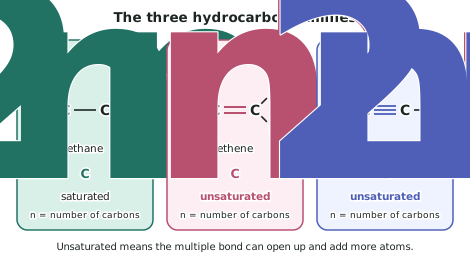
| Family | C–C bond | General formula | Saturated? |
|---|---|---|---|
| Alkane | single | saturated | |
| Alkene | one double | unsaturated | |
| Alkyne | one triple | unsaturated |
- n is the number of carbon atoms in the molecule.
- Each step from alkane to alkene to alkyne removes two hydrogen atoms, because forming an extra bond between the carbons uses up a bond each carbon was using for hydrogen.
Using a general formula
- Find the number of carbons.
- Substitute that number for n.
- Work out the hydrogen count.
Worked through for a five-carbon molecule:
- Pentane (alkane): , so → .
- Pentene (alkene): , so → .
- Pentyne (alkyne): , so → .
The first eight members
The stem of the name comes from the carbon count, and you need all eight:
| Carbons | Stem | Alkane | Alkene | Alkyne |
|---|---|---|---|---|
| 1 | meth- | methane | — | — |
| 2 | eth- | ethane | ethene | ethyne |
| 3 | prop- | propane | propene | propyne |
| 4 | but- | butane | butene | butyne |
| 5 | pent- | pentane | pentene | pentyne |
| 6 | hex- | hexane | hexene | hexyne |
| 7 | hept- | heptane | heptene | heptyne |
| 8 | oct- | octane | octene | octyne |
- There is no methene or methyne — a C=C or C≡C needs two carbons.
Why the difference matters
- Alkanes are unreactive. They are saturated: there is no double bond to open, so the only reactions they undergo are combustion and substitution with halogens under UV light.
- Alkenes and alkynes are reactive. The multiple bond can open, so they undergo addition reactions readily.
- This single difference is the basis of the bromine water test that tells them apart, and the reason alkenes are the starting point for making alcohols, haloalkanes and plastics.
Worked ExampleDeducing the family from a formula
A hydrocarbon has the molecular formula . Deduce which family it belongs to, and explain how you know. Then state whether it would decolourise bromine water.
Step 1 — Test it against the alkane formula
For an alkane with : , giving .
The compound has only 10 hydrogens, so it is not an alkane.
Step 2 — Test it against the alkene formula
For an alkene with : , giving .
Still too many hydrogens, so it is not an alkene either.
Step 3 — Test it against the alkyne formula
For an alkyne with : , giving .
This matches. The compound is an alkyne — it contains a C≡C triple bond.
Step 4 — Answer the second part
An alkyne is unsaturated, so the triple bond can open and bromine can add across it.