Major and minor products
When two products are possible
- An asymmetric alkene is one where the two carbons of the C=C are not the same.
- Propene, — one C=C carbon carries two H atoms, the other carries one H and a . Asymmetric.
- Ethene, — both carbons carry two H atoms. Symmetric.
- When you add an unsymmetrical reagent (, or ) to an asymmetric alkene, the reagent can attach two ways round, so two different products form.
- One forms in the larger amount — the major product. The other forms in the smaller amount — the minor product.
- Both are made. A question asking about an asymmetric alkene expects both to be named.
Markovnikov's rule
When or adds to an asymmetric alkene, the hydrogen adds to the double-bond carbon that already carries more hydrogen atoms. The X or the –OH goes to the other carbon.
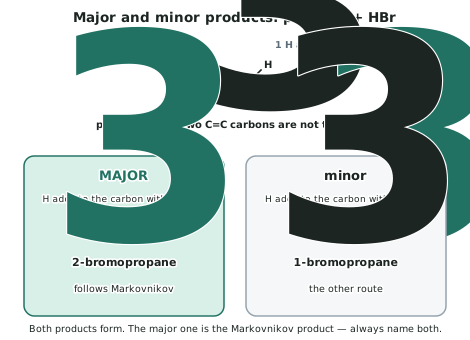
- That route gives the major product.
- The other way round gives the minor product.
- A quick way to remember it: "the rich get richer" — the carbon with more hydrogens gains another one.
The method
- Check the alkene is asymmetric. If both C=C carbons are identical, there is only one product and none of this applies.
- Check the reagent is unsymmetrical. and are; and are not — gives one product either way round.
- Count the hydrogens already on each of the two double-bond carbons.
- Put the new H on the carbon with more hydrogens.
- Put the X or –OH on the other carbon → this is the major product.
- Swap them over → this is the minor product.
- Name both and label which is which.
Worked through: propene + HBr
- The C=C is between carbon 1 (, 2 H) and carbon 2 (, 1 H).
- The new H goes to carbon 1 (more hydrogens), so the Br goes to carbon 2.
- Major: = 2-bromopropane.
- Minor: = 1-bromopropane.
The same rule for adding water
- Hydration of an asymmetric alkene works identically — the H goes to the more-hydrogenated carbon and the –OH to the other.
- Propene + :
- Major: propan-2-ol ().
- Minor: propan-1-ol ().
When the rule does not apply
- Symmetric alkene (ethene, but-2-ene) — both carbons are the same, so there is only one product.
- Symmetric reagent (, , ) — it does not matter which way round it adds, so again one product.
- Only when both the alkene and the reagent are unsymmetrical do you get a major and a minor.
Worked ExampleApplying Markovnikov to hydration
But-1-ene, , reacts with water in the presence of an acid catalyst. Identify the major and minor products, name both, and justify which is major.
Step 1 — Check that the rule applies
The C=C is between carbon 1 and carbon 2. Carbon 1 carries two H atoms; carbon 2 carries one H and a group. The two carbons are different, so the alkene is asymmetric.
The reagent is , which splits into H and –OH — unsymmetrical.
Both conditions are met, so there will be a major and a minor product.
Step 2 — Count the hydrogens on the two C=C carbons
- Carbon 1: 2 hydrogens.
- Carbon 2: 1 hydrogen.
Step 3 — Apply Markovnikov's rule
The new H adds to the carbon with more hydrogens — that is carbon 1.
So the –OH goes to carbon 2.
Step 4 — Name the major product
Four carbons, –OH on carbon 2 → butan-2-ol. This is the major product.
Step 5 — Give the minor product
Swapping them over puts the –OH on carbon 1: → butan-1-ol. This is the minor product.