Addition polymerisation
Monomers and polymers
- A monomer is a small reactive molecule that joins with many others.
- A polymer is a long-chain molecule built from many repeating units.
- In addition polymerisation, many alkene monomers join because each C=C opens up — and no atoms are lost. The polymer is the only product.
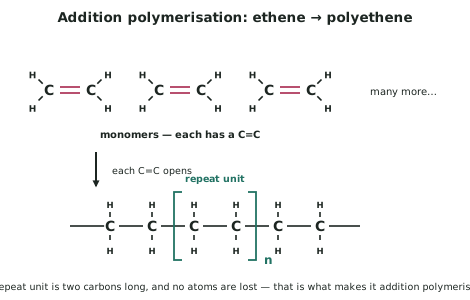
- n is a very large number — the polymer chain contains thousands of repeat units.
- The product is polyethene (polythene), used for plastic bags, bottles and pipe.
The repeat unit
- The repeat unit is the section of chain that repeats over and over.
- For an addition polymer, it is the monomer with the double bond replaced by single bonds, and with open bonds at each end to show the chain continues.
- It is drawn in square brackets with a subscript n.
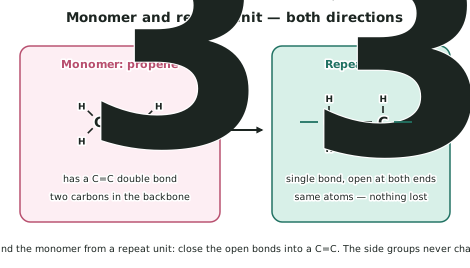
- The backbone of the repeat unit is always two carbons long, because that is the pair that used to be joined by the C=C.
- Any side groups carry through unchanged.
Going from monomer to repeat unit
- Draw the monomer with the C=C horizontal.
- Change the double bond into a single bond.
- Draw an open bond out of each of the two carbons, left and right.
- Enclose in square brackets and write n outside.
Going from repeat unit back to monomer
This direction is asked just as often:
- Find the two backbone carbons between the brackets.
- Join them with a double bond.
- Remove the open bonds at the ends.
- Keep every side group exactly where it is.
Three polymers worth knowing
| Monomer | Polymer | Where you meet it |
|---|---|---|
| ethene, | poly(ethene) | plastic bags, milk bottles |
| propene, | poly(propene) | ice-cream containers, rope |
| chloroethene, | poly(chloroethene), PVC | pipes, spouting, flooring |
- The polymer's name is the monomer's name with poly( in front and ) after.
Why it counts as addition
- Every atom in the monomers appears in the polymer — nothing is given off.
- The polymer is the only product.
- The monomers were unsaturated; the polymer is saturated.
Worked ExampleFrom monomer to polymer and back
(a) Draw the repeat unit of the polymer made from chloroethene, , and name the polymer. (b) A polymer has the repeat unit . Identify and name the monomer it was made from.
(a) Chloroethene → its polymer
Step 1 — Identify the two carbons of the C=C. They are the and the .
Step 2 — Change the double bond to a single bond. The two carbons are now joined by one bond.
Step 3 — Add an open bond to each end to show the chain continues in both directions.
The repeat unit is:
Step 4 — Name the polymer. Take the monomer name and wrap it: poly(chloroethene), commonly called PVC.
(b) Working backwards to the monomer
Step 1 — Find the two backbone carbons. Inside the brackets they are the and the . The is a side group hanging off the second carbon — it is not part of the backbone.
Step 2 — Join the two backbone carbons with a double bond, and remove the open bonds.
Step 3 — Keep the side group where it was. The stays on the second carbon.
Step 4 — Name it. Written conventionally this is — three carbons with a double bond starting at carbon 1.