Acid–base reactions of carboxylic acids and amines
Two families that behave as acid and base
- Carboxylic acids (–COOH) are weak acids — they donate a proton, .
- Primary amines (–NH2) are weak bases — they accept a proton.
- These are the only two families in this standard with acid–base chemistry, and they are opposites.
| Family | Behaves as | What it does to | Ion formed |
|---|---|---|---|
| carboxylic acid | acid | donates it | negative (carboxylate) |
| primary amine | base | accepts it | positive |
Carboxylic acids
- The –COOH group loses its hydrogen as , leaving a negatively charged carboxylate ion:
- The ion is named by changing -oic acid to -oate: ethanoic acid → the ethanoate ion.
- They are weak acids: only a small fraction of the molecules donate their proton at any moment.
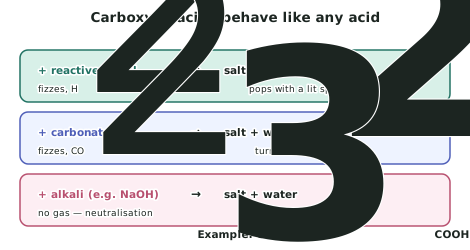
They give all the ordinary reactions of an acid:
- With a reactive metal → salt + hydrogen.
- Observation: fizzing; the gas pops with a lit splint.
- With a carbonate → salt + water + carbon dioxide.
- Observation: fizzing; the gas turns limewater milky.
- This is the standard test that tells a carboxylic acid from an alcohol.
- With an alkali → salt + water (neutralisation).
- Observation: no gas.
Primary amines
- The nitrogen of the –NH2 group accepts a proton, giving a positively charged ion:
- With an acid, an amine forms a salt:
- They are weak bases, and their solutions in water are basic — pH above 7.
An acid and an amine together
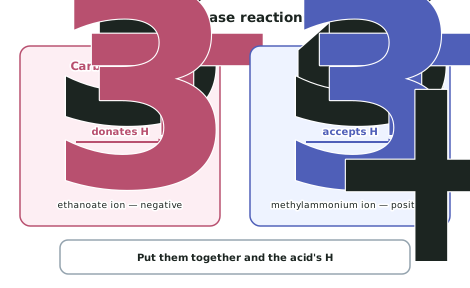
- Put a carboxylic acid and an amine together and a straightforward acid–base reaction occurs: the acid donates and the amine accepts it.
- Both ions are formed, and the product is a salt.
Distinguishing the families by their acid–base behaviour
| Test | Carboxylic acid | Alcohol | Amine |
|---|---|---|---|
| pH of aqueous solution | below 7 | about 7 | above 7 |
| Add sodium carbonate | fizzes () | no reaction | no reaction |
| Add hydrochloric acid | no visible reaction | no reaction | forms a salt |
Worked ExampleAn acid and a base reacting
(a) Write an equation for the reaction of propanoic acid with sodium carbonate, and state what would be observed. (b) Write an equation for the reaction of ethanamine () with hydrochloric acid, and explain why ethanamine behaves as a base.
(a) Propanoic acid + sodium carbonate
Step 1 — Identify the reaction type. Propanoic acid, , contains the –COOH group, so it is an acid. Acid + carbonate is a standard acid–base reaction.
Step 2 — Write the products. Acid + carbonate always gives salt + water + carbon dioxide. The salt is the sodium propanoate, .
Step 3 — Balance it. The carbonate needs two acid molecules to supply two :
Step 4 — State the observation. Fizzing / effervescence, and the gas given off turns limewater milky, confirming carbon dioxide.
(b) Ethanamine + hydrochloric acid
Step 1 — Identify the reaction type. Ethanamine contains the –NH2 group, so it is a base and will accept a proton from the acid.
Step 2 — Write the equation. The nitrogen accepts from the HCl, going from to , and the chloride balances the charge:
Step 3 — Explain the basicity. The nitrogen atom of the amino group accepts a proton (). Accepting a proton is the definition of a base, so ethanamine is a base — a weak one.