Reaction pathways: putting it all together
The map
Most Merit and Excellence questions in this standard are really the same question: how do I get from X to Y? Every reaction you have met fits on one map.
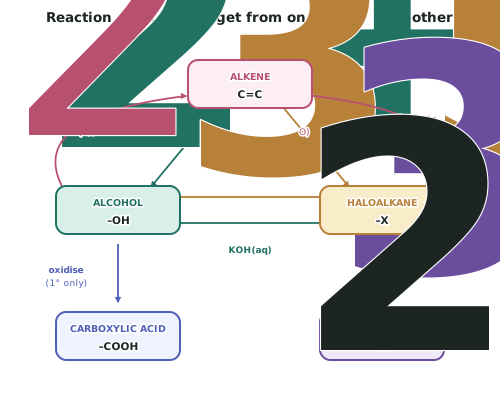
Every route, with its reagent and conditions
| From | To | Reagent and conditions | Reaction type |
|---|---|---|---|
| alkene | alkane | , Pt catalyst | addition |
| alkene | dihaloalkane | or | addition |
| alkene | alcohol | , catalyst | addition |
| alkene | haloalkane | addition | |
| alkene | diol | , cold dilute | oxidation |
| alkene | polymer | many monomers | addition polymerisation |
| alkane | haloalkane | , UV light | substitution |
| alcohol | haloalkane | , , or | substitution |
| alcohol | carboxylic acid | or , warm, 1° only | oxidation |
| alcohol | alkene | conc. , heat | elimination |
| haloalkane | alcohol | KOH(aq) | substitution |
| haloalkane | amine | substitution | |
| haloalkane | alkene | KOH in ethanol, heat | elimination |
How to answer a "convert X to Y" question
- Find X and Y on the map.
- Trace the arrows from one to the other. If they are not directly joined, you need two steps — almost always through an alcohol or a haloalkane, since those are the hubs.
- For each step, state the reagent AND the conditions.
- Name the reaction type for each step.
- Check for major/minor products: if a step involves an asymmetric alkene with or , or an elimination with two possible alkenes, say which product you need and whether it is the major or the minor one.
The three routes worth memorising
- Alkene → alcohol → carboxylic acid. Add water, then oxidise. Only works if the alcohol formed is primary.
- Alkene → haloalkane → amine. Add HX, then react with ammonia. The only route to an amine.
- Alcohol ⇄ haloalkane. / one way, KOH(aq) the other. These two families interconvert freely and are the hubs of the map.
Watch the direction of the elimination arrows
- Alcohol → alkene and haloalkane → alkene are both eliminations, and both need heat.
- They are the reverse of the addition reactions that made those compounds from an alkene in the first place.
- The conditions are what distinguish elimination from substitution, so never write a bare reagent for these steps.
Worked ExampleA two-step conversion
Show how propene could be converted into propanoic acid. Give the reagents and conditions for each step, name the reaction type, name the product of each step, and comment on the yield.
Step 1 — Locate both compounds on the map
Propene is an alkene; propanoic acid is a carboxylic acid. They are not joined directly, so a route must pass through an intermediate.
The only arrow into "carboxylic acid" comes from an alcohol, by oxidation — and that oxidation works only for a primary alcohol. So the intermediate must be a primary alcohol: propan-1-ol.
Step 2 — Propene → propan-1-ol (addition of water)
Reagent and conditions: water with an acid catalyst — concentrated , then water.
Reaction type: addition (hydration).
Propene is asymmetric, so two alcohols form. Counting the hydrogens on the C=C carbons: carbon 1 has 2 H, carbon 2 has 1 H. By Markovnikov's rule the new H joins carbon 1, putting the –OH on carbon 2:
- Major product: propan-2-ol (secondary).
- Minor product: propan-1-ol (primary).
The route needs the minor product, propan-1-ol, because only a primary alcohol can be oxidised to a carboxylic acid. The propan-2-ol must be separated off.
Step 3 — Propan-1-ol → propanoic acid (oxidation)
Reagent and conditions: acidified permanganate () or acidified dichromate, warmed.
Reaction type: oxidation.
Propan-1-ol is primary, so it is oxidised through to the carboxylic acid:
Product: propanoic acid. The permanganate goes purple → colourless.
Step 4 — Comment on the yield
Because step 1 gives propan-1-ol only as the minor product, most of the propene ends up as propan-2-ol, which is a dead end for this target. The overall yield is therefore low, and the two alcohols would need separating — by fractional distillation — before step 2.