Testing for unsaturation
What the test is for
- A test for unsaturation tells you whether a compound contains a C=C (or C≡C).
- It works because unsaturated compounds undergo addition and saturated ones do not.
- The reagent is used up when addition happens, and that shows as a colour change.
The bromine water test
- Bromine water, (aq), is orange.
- Add it to the unknown compound and shake.
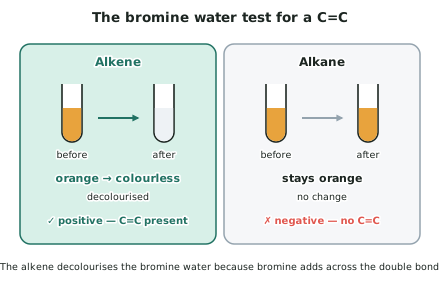
| Compound | Observation | Conclusion |
|---|---|---|
| Unsaturated (alkene, alkyne) | orange → colourless | C=C present — positive |
| Saturated (alkane) | stays orange | no C=C — negative |
- The alkene decolourises the bromine water because bromine adds across the double bond and is consumed:
- The alkane leaves it orange because there is no reaction — nothing uses the bromine up.
The permanganate test
- Acidified permanganate, , is purple and also reacts with a C=C.
- With an alkene it goes purple → colourless.
- With a saturated compound it stays purple.
- This is a second valid test, covered in full on the oxidation page.
Writing up an observation properly
Exam answers need three things, and losing any one costs marks:
-
The reagent — "bromine water" (not just "bromine").
-
The observation — "orange to colourless", giving both colours.
-
The conclusion — "so the compound is unsaturated / contains a C=C".
-
"It goes clear" is not an acceptable observation. Clear means see-through; colourless means having no colour. Orange bromine water is already clear.
Keeping the test valid
- Do the test at room temperature, out of strong ultraviolet light.
- In UV light an alkane will slowly react with bromine by substitution and decolourise it too, giving a false positive.
- Without UV, only the alkene decolourises it, so the result means what you want it to mean.
Worked ExampleDistinguishing two hydrocarbons
Two colourless liquids are known to be pentane and pent-1-ene, but the labels have fallen off. Describe a chemical test that would identify each, stating the reagent, both observations and your conclusions.
Step 1 — Choose a reagent that distinguishes saturated from unsaturated
Pentane is an alkane (saturated) and pent-1-ene is an alkene (unsaturated). The difference is the C=C, so use a reagent that reacts with a C=C: bromine water.
Step 2 — Describe the method
Take a small sample of each liquid in a test tube, add a few drops of orange bromine water to each and shake. Keep both out of direct sunlight.
Step 3 — State what is observed with the alkene
Pent-1-ene has a C=C, so bromine adds across the double bond and is used up:
Observation: orange → colourless.
Step 4 — State what is observed with the alkane
Pentane is saturated, so there is no reaction and the bromine is not consumed.
Observation: the bromine water stays orange.
Step 5 — Draw the conclusions
The sample that decolourises the bromine water is pent-1-ene; the one that leaves it orange is pentane.