Solubility, melting and boiling points
What you need to know here
For this standard you need to know how carbon-chain length and functional group affect solubility, melting point and boiling point.
You are not required to explain the underlying chemistry of why — the 2026 assessment specification states this explicitly. So learn the trends and how to apply them, and do not spend time on intermolecular-force theory for this standard.
Boiling and melting points: chain length
- The longer the carbon chain, the higher the boiling point.
- The same trend holds for melting point.
- The rise is steady and predictable as you go along a homologous series.
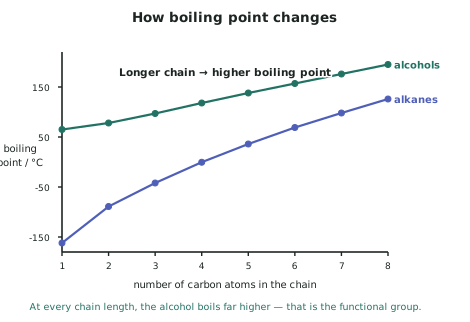
- This is why the short alkanes are gases at room temperature (methane, ethane, propane, butane), the middle ones are liquids (pentane to about hexadecane) and the long ones are solids (waxes).
Boiling and melting points: functional group
- A polar functional group raises the boiling point, compared with a hydrocarbon of a similar size.
- Reading the graph at any chain length, the alcohol always boils far higher than the alkane with the same number of carbons.
- Ethane boils at −89 °C; ethanol boils at +78 °C.
- The same applies to carboxylic acids and amines — all have polar groups and boil higher than the matching hydrocarbon.
- Ranked roughly, for the same number of carbons:
- carboxylic acid > alcohol > amine > haloalkane > alkane / alkene / alkyne
Solubility in water
- Water is polar, so it dissolves compounds that have a polar functional group.
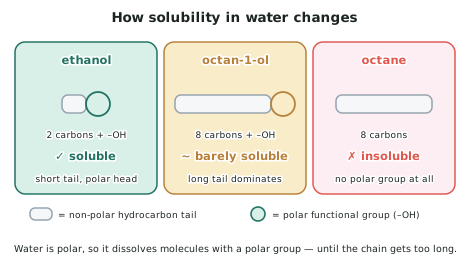
- Hydrocarbons (alkanes, alkenes, alkynes) have no polar group and are insoluble in water. They do dissolve in non-polar solvents.
- Alcohols, carboxylic acids and amines have a polar group and are soluble in water — provided the chain is short.
- As the carbon chain gets longer, water solubility falls. The long non-polar hydrocarbon part comes to dominate the molecule.
- Ethanol (2 carbons) mixes with water in any proportion.
- Butan-1-ol (4 carbons) is only partly soluble.
- Octan-1-ol (8 carbons) is almost insoluble.
Applying the two trends together
Most questions give you two compounds and ask you to compare. Take it in two steps:
- Compare the functional groups first. A polar group beats no polar group.
- Then compare the chain lengths. Longer chain means higher boiling point, but lower water solubility.
- If the two compounds have the same chain length, the difference must be the functional group. If they have the same functional group, the difference must be chain length. Say which one you are using.
Worked ExampleComparing three compounds
Ethane (), ethanol () and octan-1-ol () are compared. Predict which has the highest boiling point and which is the most soluble in water, explaining each answer.
Step 1 — Sort out what differs between each pair
Ethane and ethanol have the same two-carbon chain. The only difference is the functional group — ethanol has a polar –OH, ethane has none.
Ethanol and octan-1-ol have the same functional group (–OH). The only difference is the chain length — 2 carbons against 8.
Step 2 — Predict the boiling points
Adding a polar functional group raises the boiling point, so ethanol boils higher than ethane.
Making the chain longer raises it again, so octan-1-ol boils higher than ethanol.
Order: ethane < ethanol < octan-1-ol.
Step 3 — Predict the water solubility
Ethane has no polar group, so it is insoluble.
Octan-1-ol has a polar –OH, but its eight-carbon chain is long, and a longer chain reduces water solubility — so it is only very slightly soluble.
Ethanol has a polar –OH and a short chain, so both factors favour dissolving.