Reactions of alkanes
Why alkanes barely react
- Alkanes are saturated — every carbon already holds four atoms, and there is no double bond to open.
- So there is nothing for a reagent to add to. The only way to change an alkane is to take a hydrogen off and put something in its place.
- At Level 2 alkanes do exactly two things: burn, and react with halogens in UV light.
Combustion
- Alkanes burn in plenty of oxygen to give carbon dioxide and water.
- The reaction is strongly exothermic, which is why alkanes are used as fuels — LPG in a barbecue, petrol in a car, natural gas.
- To balance a combustion equation: balance the carbons first, then the hydrogens, then finally the oxygens.
Substitution with halogens
- In ultraviolet light, a halogen atom replaces a hydrogen atom on the alkane.
- This is a substitution reaction — one atom swapped for another, nothing added.
- At Level 2 it is limited to monosubstitution: one hydrogen is replaced.
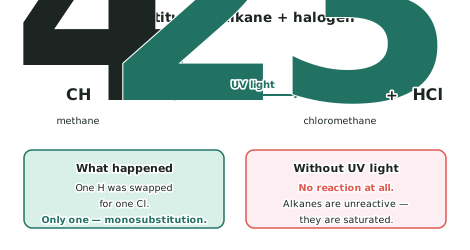
- The conditions matter. Without UV light there is no reaction at all — this is worth stating whenever you write the equation.
- The other product is always the hydrogen halide (HCl here), because the displaced hydrogen has to go somewhere.
- The same happens with bromine: .
Writing the products
- Identify which hydrogen is replaced — with a symmetrical alkane like methane or ethane it makes no difference.
- Replace it with one halogen atom.
- Write the hydrogen halide as the second product.
- Name the product as a haloalkane: is chloroethane.
Comparing the two reaction types
| Alkane | Alkene | |
|---|---|---|
| Saturated? | saturated | unsaturated |
| Reacts with in the dark? | no | yes |
| Reaction type with halogen | substitution (UV needed) | addition |
| Second product | HX | none — nothing is lost |
- This table is the reason the bromine water test works, and it is a common Merit question.
Worked ExampleAlkane substitution
Ethane is mixed with bromine and the mixture is exposed to ultraviolet light. Write a balanced equation for the reaction, name the organic product, and state the reaction type. Explain what would happen if the mixture were kept in the dark instead.
Step 1 — Identify the reaction type
Ethane is an alkane, so it is saturated — nothing can add to it. With a halogen under UV light it undergoes substitution: one hydrogen is replaced by a bromine atom.
Step 2 — Build the products
Take one H off ethane and put a Br in its place: .
The displaced hydrogen joins the leftover bromine to form HBr.
Step 3 — Write and check the balanced equation
Checking: 2 C each side ✓, 6 H each side ✓, 2 Br each side ✓.
Step 4 — Name the organic product
Two carbons with one bromine on an end carbon → bromoethane.
Step 5 — Answer the "in the dark" part
The UV light is required to start this reaction. Without it, no reaction occurs and the bromine keeps its colour.