Primary, secondary and tertiary
What classification means
Alcohols and haloalkanes are sorted into three classes. The classification is an explicit requirement of this standard, and it decides how the compound reacts — so it is worth getting fast at.
- Find the carbon that carries the functional group (the –OH or the –X).
- Count how many other carbon atoms are joined to that carbon.
- one → primary (1°)
- two → secondary (2°)
- three → tertiary (3°)
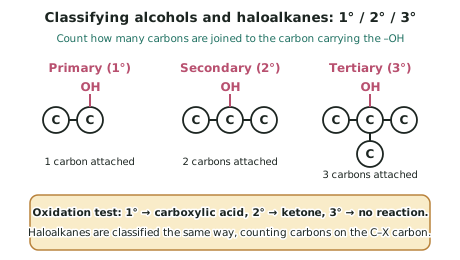
- You are counting carbons attached to that one carbon — not the total number of carbons in the molecule, and not the number of hydrogens.
The same rule for haloalkanes
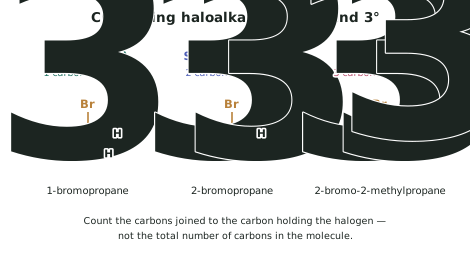
- 1-bromopropane, — the C–Br carbon touches one carbon → primary.
- 2-bromopropane, — the C–Br carbon touches two carbons → secondary.
- 2-bromo-2-methylpropane, — the C–Br carbon touches three carbons → tertiary.
The special case: methanol
- Methanol, , has no other carbon attached to the –OH carbon.
- It is normally treated as primary, and it oxidises like a primary alcohol.
Why it matters
Classification is not just labelling — it changes the chemistry:
- Oxidation of alcohols depends entirely on the class:
- primary → carboxylic acid
- secondary → ketone
- tertiary → no reaction at all
- That last one is genuinely useful: a tertiary alcohol leaves acidified permanganate purple, so "no colour change" is the identification.
How to classify quickly
- Find the functional group.
- Put your finger on the carbon it is attached to.
- Count the carbon atoms touching that carbon: 1, 2 or 3.
- Ignore everything else in the molecule.
Worked ExampleClassifying three alcohols
Classify each of these alcohols as primary, secondary or tertiary, and state what each would give on oxidation with acidified permanganate: (a) butan-1-ol, ; (b) butan-2-ol, ; (c) 2-methylpropan-2-ol, .
(a) butan-1-ol
The –OH is on carbon 1, the end of the chain. That carbon is joined to carbon 2 only — one carbon.
Primary (1°). A primary alcohol is oxidised to a carboxylic acid, so it gives butanoic acid.
(b) butan-2-ol
The –OH is on carbon 2. That carbon is joined to carbon 1 and carbon 3 — two carbons.
Secondary (2°). A secondary alcohol is oxidised to a ketone.
(c) 2-methylpropan-2-ol
The –OH is on the central carbon. That carbon is joined to three groups — three carbons, and no hydrogen on the –OH carbon.
Tertiary (3°). A tertiary alcohol is not oxidised — there is no reaction, and the permanganate stays purple.