Substitution reactions of haloalkanes
Swapping the halogen out
- A haloalkane's halogen can be replaced by another group, in a substitution reaction.
- At Level 2 there are exactly two reagents to know: aqueous potassium hydroxide and ammonia.
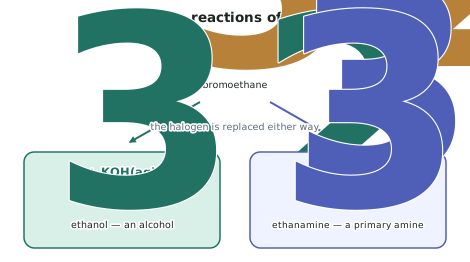
| Reagent | Group that replaces the halogen | Product family |
|---|---|---|
| KOH(aq) — potassium hydroxide in water | –OH | alcohol |
| — ammonia | –NH2 | primary amine |
With aqueous potassium hydroxide
- The –Br is replaced by –OH, giving ethanol.
- The solvent is critical: the KOH must be dissolved in water.
- If the KOH is dissolved in ethanol and heated instead, you get a completely different reaction — elimination to an alkene. That is the next page.
With ammonia
- The –Br is replaced by –NH2, giving the primary amine ethanamine.
- This is the only route to an amine in this standard, so a question asking you to make an amine always passes through a haloalkane.
Working out the product
- Find the carbon carrying the halogen.
- Replace the halogen with –OH (if KOH(aq)) or –NH2 (if ) — on the same carbon.
- Leave the skeleton unchanged, keeping the same locant.
- Name the product.
Worked through:
- 2-bromopropane + KOH(aq) → –OH on carbon 2 → propan-2-ol.
- 1-bromopropane + → –NH2 on carbon 1 → propan-1-amine.
Where this sits on the reaction map
- Haloalkane → alcohol with KOH(aq).
- Haloalkane → amine with .
- Both are the reverse direction of routes you already know: an alcohol becomes a haloalkane with HX or , and a haloalkane becomes an alcohol with KOH(aq). That two-way link between alcohols and haloalkanes is used constantly in multi-step questions.
Worked ExampleMaking an amine
Starting from 1-bromobutane, describe how propan-1-amine's four-carbon equivalent, butan-1-amine, could be prepared. Give the reagent, the equation, and the reaction type. Then state what would be formed instead if aqueous potassium hydroxide were used.
Step 1 — Identify what must change
The starting material is , with the bromine on carbon 1.
The target, butan-1-amine, is — the –NH2 is on carbon 1, exactly where the bromine was.
So the halogen must be substituted by an –NH2 group, in place.
Step 2 — Choose the reagent
The reagent that replaces a halogen with –NH2 is ammonia, .
Step 3 — Write the equation
The displaced bromine leaves as HBr.
Step 4 — Name the reaction type
The halogen has been swapped for another group on the same carbon, with a second product formed. This is a substitution reaction.
Step 5 — Answer the second part
With aqueous potassium hydroxide the halogen would be replaced by –OH instead:
That gives butan-1-ol, an alcohol.