Constitutional isomers
What isomers are
- Isomers have the same molecular formula but a different arrangement of atoms.
- They are different substances, with different melting points, boiling points and sometimes different reactions.
- Level 2 covers two kinds: constitutional isomers (this page) and geometric isomers (next page).
Constitutional isomers
- Constitutional isomers (also called structural isomers) have their atoms joined together in a different order.
- Same molecular formula, different structural formula.
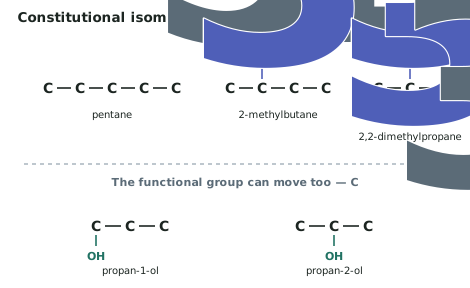
There are two ways the order can differ, and questions use both:
Different carbon skeletons
- The chain can be straight or branched.
- gives three compounds:
- pentane — an unbranched chain of five carbons.
- 2-methylbutane — a four-carbon chain with a methyl branch on carbon 2.
- 2,2-dimethylpropane — a three-carbon chain with two methyl branches on carbon 2.
- All three have exactly 5 C and 12 H. They are different compounds — pentane boils at 36 °C, 2,2-dimethylpropane at 9.5 °C.
Different positions for the functional group
- The functional group can sit on a different carbon.
- gives two alcohols:
- propan-1-ol — –OH on an end carbon (primary).
- propan-2-ol — –OH on the middle carbon (secondary).
- These behave differently: propan-1-ol oxidises to a carboxylic acid, propan-2-ol to a ketone.
Finding all the isomers of a formula
Work through it systematically or you will miss one:
- Draw the longest straight chain first.
- Shorten the chain by one carbon and put the spare carbon on as a methyl branch — try every position on the chain.
- Shorten again and place two branches — again try every position.
- Move the functional group along each skeleton in turn.
- Check for duplicates: two drawings are the same compound if you can get from one to the other by rotating or flipping. Name each structure, and if two share a name they are the same compound.
For , this gives just two: butane and 2-methylpropane. There is no "3-methylpropane" — numbering from the other end makes it 2-methylpropane, the same molecule.
Worked ExampleFinding every isomer of a formula
Draw and name all the alcohols with the molecular formula .
Step 1 — Start with the longest chain, and move the –OH along it
The longest chain is four carbons: C–C–C–C.
- –OH on carbon 1 → = butan-1-ol.
- –OH on carbon 2 → = butan-2-ol.
- –OH on carbon 3? Numbering from the other end makes this carbon 2 — it is butan-2-ol again. Not a new isomer.
- –OH on carbon 4? Same as carbon 1 — butan-1-ol again.
So the straight chain gives two isomers.
Step 2 — Shorten the chain and add a branch
Use a three-carbon chain with a methyl branch on carbon 2:
– with the –OH still to place.
- –OH on carbon 1 → = 2-methylpropan-1-ol.
- –OH on carbon 2 (the branched carbon) → = 2-methylpropan-2-ol.
Step 3 — Check nothing is left
A two-carbon chain cannot hold four carbons, so there are no further skeletons. Every structure has a different name, so there are no duplicates.
Step 4 — Check each formula
Each has 4 C, 10 H and 1 O. ✓