Naming organic compounds (IUPAC)
How an IUPAC name is built
An IUPAC name is a code. Read it properly and you know exactly which molecule is meant — every part of the name carries information.
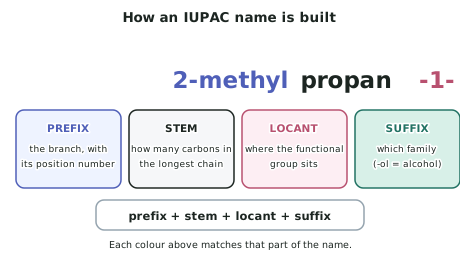
- Prefix — the branches, each with the number of the carbon it sits on.
- Stem — how many carbons are in the longest chain.
- Locant — the number saying where the functional group is.
- Suffix — which family the compound belongs to.
Step 1 — Find the longest chain
- Find the longest continuous chain of carbon atoms that contains the functional group.
- The chain does not have to be drawn in a straight line — follow it round corners.
- The number of carbons gives the stem:
| Carbons | 1 | 2 | 3 | 4 | 5 | 6 | 7 | 8 |
|---|---|---|---|---|---|---|---|---|
| Stem | meth- | eth- | prop- | but- | pent- | hex- | hept- | oct- |
- Any carbon not in that chain becomes a branch.
Step 2 — Number the chain
- Number from the end that gives the functional group the lowest number.
- If there is no functional group (a plain alkane), number from the end that gives the first branch the lowest number.
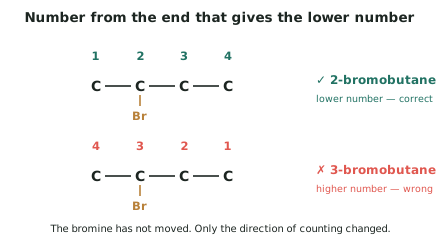
- Always try both ends and compare. The molecule has not changed — only your counting.
Step 3 — Add the suffix for the family
| Family | Ending | Example |
|---|---|---|
| alkane | -ane | propane |
| alkene | -ene | prop-1-ene |
| alkyne | -yne | prop-1-yne |
| alcohol | -ol | propan-1-ol |
| primary amine | -amine | propan-1-amine |
| carboxylic acid | -oic acid | propanoic acid |
| haloalkane | prefix: fluoro-, chloro-, bromo-, iodo- | 2-bromopropane |
- The haloalkane is the odd one out: the halogen goes in the prefix, not the suffix.
- Carboxylic acids need no locant — the –COOH carbon is always carbon 1, because the chain must end there.
Step 4 — Name the branches
- A branch is named after the number of carbons in it, ending in -yl:
- – = methyl, – = ethyl, – = propyl.
- Put the number of the carbon it sits on in front: 2-methyl, 3-ethyl.
- If the same branch appears more than once, use di- (2), tri- (3), tetra- (4), and list every position.
- -dimethylbutane — two methyl branches, one on carbon 2 and one on carbon 3.
- If there are different branches, list them in alphabetical order.
- 4-ethyl-2-methylhexane — ethyl before methyl.
Step 5 — Punctuation
- Numbers are separated from each other by commas: 2,3-dimethyl.
- Numbers are separated from letters by hyphens: 2-bromo, propan-1-ol.
- No spaces, except before "acid".
Putting it together
- → 3 carbons, –OH on carbon 1 → propan-1-ol.
- → 3 carbons, Cl on carbon 2 → 2-chloropropane.
- → 4 carbons, C=C starting at carbon 2 → but-2-ene.
- → 3 carbons, –COOH → propanoic acid.
- → 3 carbons, –NH2 on carbon 1 → propan-1-amine.
Worked ExampleNaming a branched compound
Give the IUPAC name of .
Step 1 — Find the longest chain containing the functional group
The functional group is the –OH. Following the chain from the –OH carbon: that carbon, then the , then , then — that is 4 carbons.
The in brackets is not part of that chain, so it is a branch.
Stem: but-. Suffix: -ol.
Step 2 — Number for the lowest locant on the functional group
Numbering from the –OH end puts the –OH on carbon 1. Numbering from the other end would put it on carbon 4.
Carbon 1 is lower, so number from the –OH end: butan-1-ol.
Step 3 — Locate the branch using that numbering
Counting from the same end: carbon 1 is the , carbon 2 is the carrying the branch.
The branch is a group → methyl, on carbon 2 → 2-methyl.
Step 4 — Assemble the name
Branch (with its number) first, then the stem, then the locant of the functional group, then the suffix:
2-methyl + butan + -1- + ol