Elimination reactions
What elimination is
- In an elimination reaction a small molecule is removed from a compound, and a C=C double bond forms where it left.
- The product is always an alkene.
- Two starting materials do this at Level 2:
- alcohols lose water (a dehydration),
- haloalkanes lose a hydrogen halide.
- Elimination is the reverse of addition — addition opens a double bond, elimination creates one.
Elimination from an alcohol: dehydration
- Conditions: concentrated sulfuric acid, heated (hot aluminium oxide also works).
- The –OH leaves from one carbon and an H leaves from an adjacent carbon. Together they make water.
- Ethanol → ethene.
- This is exactly the reverse of hydrating an alkene to make an alcohol.
Elimination from a haloalkane
- Conditions: KOH dissolved in ethanol, heated.
- The halogen leaves from one carbon and an H leaves from an adjacent carbon, together forming a hydrogen halide.
The conditions decide everything
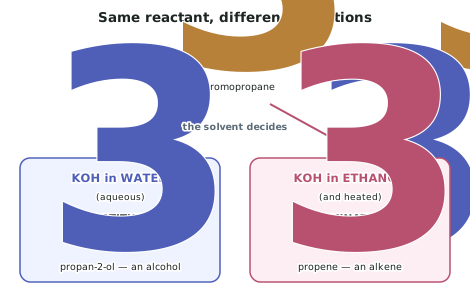
This is the most important contrast in the whole standard, and it is a favourite exam question:
| Conditions | Reaction | Product |
|---|---|---|
| KOH in water | substitution | an alcohol |
| KOH in ethanol, heated | elimination | an alkene |
- Same haloalkane, same reagent — only the solvent differs, and the product changes family.
Major and minor products in elimination
- If the hydrogen can be taken from either side of the functional-group carbon, two different alkenes are possible.
- The major product is the more substituted alkene — the one with more carbon groups attached to the C=C carbons.
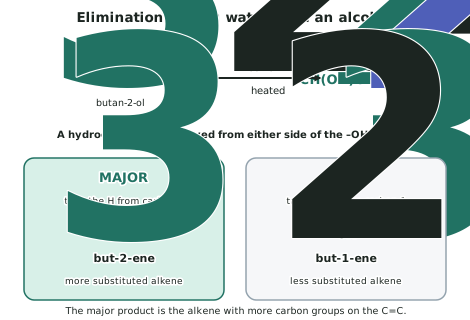
Worked through for butan-2-ol, :
- The –OH is on carbon 2. A hydrogen can be removed from carbon 1 or from carbon 3.
- Removing it from carbon 3 puts the double bond between carbons 2 and 3 → but-2-ene. Each C=C carbon carries a carbon group — more substituted. MAJOR.
- Removing it from carbon 1 puts the double bond between carbons 1 and 2 → but-1-ene. Carbon 1 carries only hydrogens — less substituted. MINOR.
The method
- Find the carbon carrying the –OH or the halogen.
- List the adjacent carbons that have at least one hydrogen.
- For each, remove that H and the functional group, and put a double bond between the two carbons.
- Compare the alkenes: the one with more carbon groups on the C=C is the major product.
- Name both, and label which is which.
Worked ExampleElimination with two possible products
2-bromobutane is heated with potassium hydroxide dissolved in ethanol. Identify the major and minor products, name both, and justify which is major.
Step 1 — Identify the reaction from the conditions
The KOH is dissolved in ethanol and the mixture is heated. These are elimination conditions, so a hydrogen halide (HBr) will be removed and an alkene will form.
(Had the KOH been in water, this would instead have been a substitution giving butan-2-ol.)
Step 2 — Find where the hydrogen can come from
2-bromobutane is . The bromine is on carbon 2.
The hydrogen must come from a carbon next to carbon 2 — so from carbon 1 or carbon 3. Both have hydrogens, so two products are possible.
Step 3 — Work out both alkenes
Taking the H from carbon 3: the double bond forms between carbons 2 and 3.
Taking the H from carbon 1: the double bond forms between carbons 1 and 2.
Step 4 — Decide which is major
Count the carbon groups attached to the two C=C carbons:
- But-2-ene — carbon 2 carries a and carbon 3 carries a . Two carbon groups — more substituted.
- But-1-ene — carbon 1 carries only two hydrogens; carbon 2 carries one . One carbon group — less substituted.
The more substituted alkene is the major product.