The seven families and their functional groups
What a functional group is
- A functional group is the atom or bond in a molecule where the chemistry happens.
- The rest of the molecule — the carbon–hydrogen skeleton — is mostly unreactive.
- Compounds sharing a functional group are grouped into a family (a homologous series).
- Every member of a family:
- has the same functional group, so they all react the same way,
- differs from the next member by one unit,
- fits one general formula.
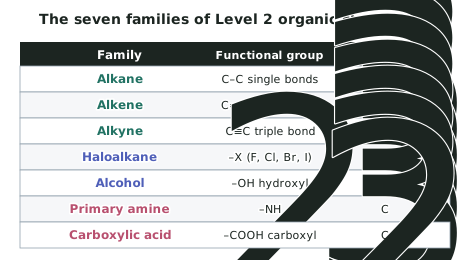
At Level 2 you are only ever asked about these seven families, with chains of no more than eight carbons.
The three hydrocarbon families
A hydrocarbon contains only carbon and hydrogen. There are three, and they differ only in the carbon–carbon bond:
-
Alkane — only C–C single bonds. Saturated.
-
Alkene — contains a C=C double bond. Unsaturated.
-
Alkyne — contains a C≡C triple bond. Unsaturated.
-
"Saturated" means every carbon already holds as many hydrogen atoms as it can — nothing more can be added.
-
"Unsaturated" means there is a double or triple bond that can open up and let extra atoms add on.
The four families with a functional group attached
These are an alkane skeleton with one hydrogen swapped for something else:
-
Haloalkane — a halogen atom (F, Cl, Br or I, written generally as –X).
- Example: , bromoethane.
-
Alcohol — the hydroxyl group, –OH.
- Example: , ethanol.
-
Primary amine — the amino group, –NH2.
- Example: , ethanamine.
-
Carboxylic acid — the carboxyl group, –COOH.
- Example: , ethanoic acid.
-
Note the –OH in a carboxylic acid is not an alcohol. It is attached to a carbon that already carries a double-bonded oxygen, and that changes its behaviour completely — the group is acidic.
Why the functional group is the first thing to find
- The functional group tells you which family the compound belongs to.
- The family tells you what it reacts with and what it turns into.
- It also decides the ending of the name (–ol, –amine, –oic acid…).
So the habit to build is: look at the structure, find the functional group, name the family — then answer the question.
Worked ExampleIdentifying the family from a structure
Name the family each of these belongs to, and state the functional group: (a) ; (b) ; (c) ; (d) .
(a)
Scan for anything that is not C or H. There is an on the end carbon.
Family: primary amine. Functional group: the amino group, –NH2.
(b)
Only carbon and hydrogen, so it is a hydrocarbon. The "=" tells you there is a double bond between two carbons.
Family: alkene. Functional group: the C=C double bond.
(c)
There is an O and an H, so check carefully. COOH means the final carbon holds a double-bonded O and an –OH.
Family: carboxylic acid. Functional group: the carboxyl group, –COOH.
(d)
There is a chlorine atom on the middle carbon, replacing a hydrogen.
Family: haloalkane. Functional group: the halogen, –Cl.