Oxidation of alkenes
Alkenes and permanganate
- Alkenes are oxidised by permanganate, .
- Under cold, dilute conditions, an –OH group adds to each carbon of the C=C, giving a diol — a compound with two hydroxyl groups on adjacent carbons.
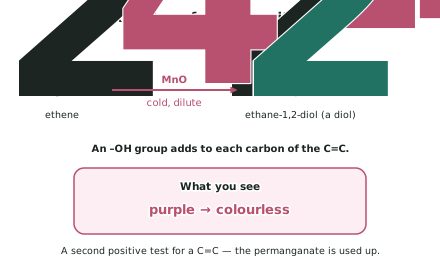
- The product from ethene is ethane-1,2-diol — the compound used as antifreeze.
- Note both locants and the "di": the two –OH groups sit on adjacent carbons, carbons 1 and 2.
What you observe
- Acidified permanganate is purple.
- With an alkene it is decolourised: purple → colourless.
- This makes it a second test for unsaturation, alongside bromine water.
| Reagent | Colour before | Colour after (with an alkene) |
|---|---|---|
| bromine water | orange | colourless |
| acidified permanganate | purple | colourless |
- A saturated compound leaves both reagents unchanged.
Working out the product
- Find the C=C.
- Break it to a single bond.
- Add an –OH to each of the two carbons.
- Check each carbon still has four bonds.
- Name the product as a diol, giving both locants.
Worked through for propene:
- The C=C is between carbons 1 and 2, so an –OH goes on each.
- Name: three carbons, –OH on carbons 1 and 2 → propane-1,2-diol.
Why this is not a Markovnikov situation
- Both halves of the reagent that add are –OH groups — they are identical.
- So it makes no difference which carbon gets which, and there is only one product.
- Major and minor products never arise here, even with an asymmetric alkene.
Worked ExampleOxidising an asymmetric alkene
But-1-ene, , is shaken with cold dilute acidified potassium permanganate. Give the structural formula and name of the organic product, state the colour change observed, and explain why only one product forms even though but-1-ene is asymmetric.
Step 1 — Locate the double bond
The C=C is between carbon 1 and carbon 2.
Step 2 — Add an –OH to each of those carbons
Break the double bond to a single bond and attach an –OH to carbon 1 and another to carbon 2:
Step 3 — Check the valencies
Carbon 1: bonds to C2, one –OH and two H = four ✓ Carbon 2: bonds to C1, C3, one –OH and one H = four ✓
Step 4 — Name the product
Four carbons in the chain (butane), with –OH groups on carbons 1 and 2, and two of them (di):
butane-1,2-diol
Step 5 — State the observation
The permanganate is used up, so the colour goes from purple to colourless.
Step 6 — Explain why there is no major/minor
But-1-ene is asymmetric — carbon 1 has two hydrogens and carbon 2 has one. But both of the groups being added are –OH groups, so they are identical. Swapping them over produces exactly the same molecule.