The four structure types
Bonding, structure, properties
Every substance in this standard fits one of four structure types. Identify the structure and you can predict every property — that is the whole method.
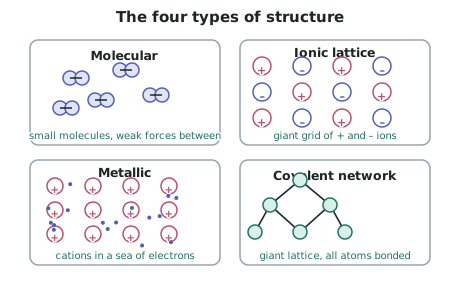
| Structure | Particles present | Held together by |
|---|---|---|
| Molecular | separate molecules | weak forces between molecules |
| Ionic | positive and negative ions in a giant lattice | strong electrostatic attraction |
| Metallic | positive ions + delocalised electrons | attraction between ions and the electron sea |
| Covalent network | atoms in a giant lattice | strong covalent bonds throughout |
Giant or simple?
This is the distinction that drives everything:
-
Simple molecular — small, separate particles. Melting only separates molecules from each other, so it needs little energy.
-
Giant (ionic, metallic, covalent network) — one continuous structure of billions of particles. Melting means breaking strong bonds throughout the whole structure, so it needs a lot of energy.
-
There are only two simple/giant categories but four structure types, because three of the four are giant.
Covalent network — the one people forget
-
A covalent network (or giant covalent) substance has atoms joined by covalent bonds extending through the entire structure.
-
There are no molecules — the whole crystal is effectively one giant molecule.
-
Examples: diamond, graphite, silicon dioxide (sand, quartz).
-
The contrast with molecular is the important one: both are covalent, but one is separate small molecules and the other is a giant lattice. That is why is a gas and melts at 1710 °C, despite both being covalently bonded non-metal oxides.
Identifying the structure
-
Metal only → metallic
-
Metal + non-metal → ionic
-
Non-metals only → covalent, and then:
- a small formula with a low melting point → simple molecular
- a very high melting point and hard → covalent network
-
The common covalent network substances are worth simply knowing: diamond, graphite, silicon dioxide, silicon carbide.
What each structure predicts
| Melting point | Conducts? | Hardness | |
|---|---|---|---|
| Molecular | low | never | soft |
| Ionic | high | molten/dissolved only | hard but brittle |
| Metallic | high | always | malleable, ductile |
| Covalent network | very high | no (graphite is the exception) | very hard |
- Each of these is explained in full on the pages that follow. Everything traces back to what is holding the particles together and whether there are charged particles free to move.
Worked ExampleIdentifying a structure from data
Four substances W, X, Y and Z were tested. Use the data to identify the structure type of each, giving a reason.
| Substance | Melting point / °C | Conducts as solid? | Conducts when molten? |
|---|---|---|---|
| W | −101 | no | no |
| X | 801 | no | yes |
| Y | 1085 | yes | yes |
| Z | 1710 | no | no |
Substance W — melting point −101 °C
An extremely low melting point means the particles are separated very easily, so only weak forces are being overcome. That points to separate molecules with weak forces between them.
It never conducts, so there are no charged particles free to move — consistent with neutral molecules.
W is simple molecular.
Substance Y — conducts as a solid
Conducting as a solid is the giveaway. The only structure with charged particles free to move while solid is metallic, where the delocalised electrons move.
Its high melting point (1085 °C) fits the many strong attractions between the ions and the electron sea.
Y is metallic.
Substance X — conducts only when molten
This is the classic ionic signature. As a solid the ions are locked in the lattice and cannot move, so it does not conduct. When molten the ions are free to move, so it does.
The high melting point (801 °C) fits a giant lattice of strong electrostatic attractions.
X is ionic.
Substance Z — very high melting point, never conducts
A melting point of 1710 °C means very strong bonds throughout a giant structure. But unlike X and Y it never conducts, so there are no ions and no delocalised electrons — the particles must be neutral atoms.
Strong bonds in a giant structure with no charged particles → covalent network.
Z is covalent network.