Bond polarity and molecular polarity
Two separate questions
Polarity has to be answered in two steps, and mixing them up is where most marks are lost:
- Are the bonds polar? — decided by the atoms.
- Is the molecule polar? — decided by the shape.
A molecule can have polar bonds and still be non-polar overall. That is the whole point of the topic.
Step 1 — Is the bond polar?
- Electronegativity is how strongly an atom pulls on the shared electrons in a bond.
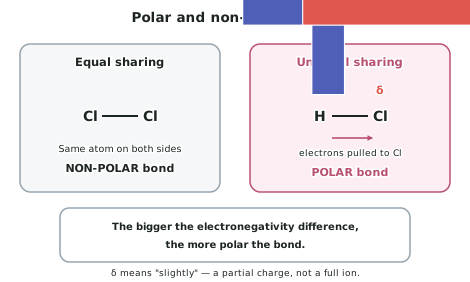
- If the two atoms have different electronegativities, the shared pair is pulled closer to one of them.
- That atom becomes slightly negative, δ−.
- The other becomes slightly positive, δ+.
- This unequal sharing makes a polar bond.
-
Same atoms → equal sharing → non-polar bond. (, )
-
Different atoms → unequal sharing → polar bond. (, , )
-
δ means "slightly" — a partial charge, not a full ionic charge.
-
Electronegativity increases across a period and up a group, so F, O, N and Cl are the strong pullers you will meet most.
Step 2 — Is the molecule polar?
- Each polar bond gives a small pull in a particular direction.
- Whether the molecule is polar depends on whether those pulls cancel out.
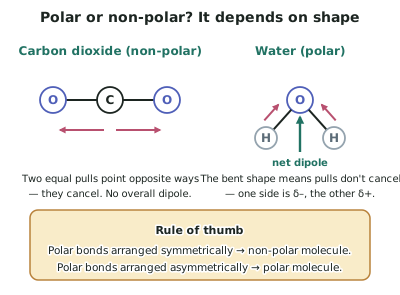
- Symmetrical shape, identical bonds → the pulls cancel → the molecule is NON-POLAR.
- Unsymmetrical shape, or a lone pair on the central atom → the pulls do not cancel → the molecule is POLAR.
The two classic examples
- Carbon dioxide, — the C=O bonds are polar, but the molecule is linear, so the two equal pulls point in exactly opposite directions and cancel. is non-polar.
- Water, — the O–H bonds are polar, and the molecule is bent, so the two pulls point partly the same way and do not cancel. Water is polar.
Same reasoning, opposite answers — and the only difference is the shape.
The method
- Identify the bonds. Different atoms → polar bond.
- Work out the shape (from the previous page).
- Ask whether the shape is symmetrical with all the outer atoms the same:
- yes → the pulls cancel → non-polar molecule
- no → they do not cancel → polar molecule
- A lone pair on the central atom almost always makes the molecule polar, because it breaks the symmetry.
Worked through:
| Molecule | Bonds | Shape | Cancel? | Molecule |
|---|---|---|---|---|
| polar | tetrahedral, symmetrical | yes | non-polar | |
| polar | tetrahedral, symmetrical | yes | non-polar | |
| polar | tetrahedral but not symmetrical | no | polar | |
| polar | pyramidal, lone pair | no | polar | |
| polar | linear, symmetrical | yes | non-polar | |
| polar | bent, two lone pairs | no | polar |
Worked ExampleDeciding whether a molecule is polar
Explain whether (a) and (b) are polar molecules. In each case discuss the bonds and the shape.
(a) (tetrachloromethane)
Step 1 — Are the bonds polar? The bonds are C–Cl. Carbon and chlorine are different atoms with different electronegativities, and chlorine is the stronger puller. Each bond is therefore polar, with δ− on the Cl and δ+ on the C.
Step 2 — What is the shape? Carbon has four bonding pairs and no lone pairs → tetrahedral, 109.5°.
Step 3 — Do the pulls cancel? All four outer atoms are identical (all chlorine), and they are arranged completely symmetrically around the carbon. Each bond pulls with the same strength, and the four pulls are spread evenly in all directions, so they cancel exactly.
Conclusion: has polar bonds but is a NON-POLAR molecule.
(b) (ammonia)
Step 1 — Are the bonds polar? The bonds are N–H. Nitrogen and hydrogen are different atoms, and nitrogen pulls the electrons more strongly. Each N–H bond is polar, with δ− on the N.
Step 2 — What is the shape? Nitrogen has 3 bonding pairs and 1 lone pair → pyramidal, 107°.
Step 3 — Do the pulls cancel? The three N–H bonds all point downwards from the nitrogen — they are on the same side of the molecule, because the lone pair occupies the fourth position. The shape is not symmetrical, so the three pulls add together rather than cancelling, giving a net pull towards the nitrogen.
Conclusion: is a POLAR molecule.