Solubility in polar and non-polar solvents
Like dissolves like
The rule for this whole page:
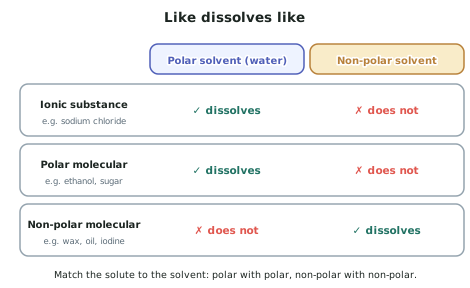
Polar and ionic substances dissolve in polar solvents. Non-polar substances dissolve in non-polar solvents.
- The 2026 assessment specification states that solubility in this standard means solubility in polar and non-polar solvents — so every question comes down to matching the solute to the solvent.
The two kinds of solvent
- Polar solvents — made of polar molecules. Water is the one you will meet most; ethanol is another.
- Non-polar solvents — made of non-polar molecules. Examples: hexane, cyclohexane, petrol, oil.
What dissolves in what
| Solute | In a polar solvent (water) | In a non-polar solvent |
|---|---|---|
| Ionic (NaCl) | ✓ dissolves | ✗ does not |
| Polar molecular (ethanol, sugar) | ✓ dissolves | ✗ does not |
| Non-polar molecular (iodine, wax, oil) | ✗ does not | ✓ dissolves |
| Metallic | ✗ does not | ✗ does not |
| Covalent network | ✗ does not | ✗ does not |
Why ionic substances dissolve in water
-
Water molecules are polar — they have a δ− oxygen end and δ+ hydrogen ends.
-
The δ− end is attracted to the positive ions in the lattice and the δ+ ends to the negative ions.
-
These attractions pull the ions out of the lattice, and each freed ion becomes surrounded by water molecules.
-
The lattice breaks up and the substance dissolves — and because the ions are now free to move, the solution conducts electricity.
-
A non-polar solvent has no δ+ or δ− ends, so it cannot attract the ions strongly enough to pull them out of the lattice. Ionic substances are therefore insoluble in non-polar solvents.
Why non-polar substances do not dissolve in water
- A non-polar solute has no charges for the polar water molecules to be attracted to.
- Water molecules attract each other more strongly than they attract the solute, so they stay together and the solute is excluded.
- This is why oil and water do not mix, and why a greasy pan will not rinse clean with water alone.
Giant structures do not dissolve
- Metallic and covalent network substances are generally insoluble in everything.
- The forces throughout their giant structures are far too strong for any solvent to pull the particles apart.
Worked ExamplePredicting and explaining solubility
Iodine () is almost insoluble in water but dissolves readily in hexane. Sodium chloride behaves in the opposite way. Explain both observations.
Step 1 — Classify the two solutes
Iodine, — a molecule of two identical atoms, so the bond is non-polar and there is nothing to make the molecule polar. Iodine is a non-polar molecular substance.
Sodium chloride, NaCl — a metal with a non-metal, so it is ionic, a giant lattice of and ions.
Step 2 — Classify the two solvents
Water — a bent molecule with polar O–H bonds whose pulls do not cancel, so water is a polar solvent.
Hexane — a hydrocarbon made of C and H only, arranged symmetrically, so it is a non-polar solvent.
Step 3 — Explain iodine in each solvent
In water: iodine molecules are non-polar, so they have no charges for the polar water molecules to be attracted to. The water molecules attract each other more strongly than they attract the iodine, so the iodine is excluded — it is almost insoluble.
In hexane: both the solute and the solvent are non-polar, so the attractions between iodine molecules and hexane molecules are similar to those the iodine molecules had for each other. Nothing prevents them mixing, so iodine dissolves readily.
Step 4 — Explain sodium chloride in each solvent
In water: the water molecules are polar. Their δ− oxygen ends are attracted to the ions and their δ+ hydrogen ends to the ions. These attractions are strong enough to pull the ions out of the lattice, so the lattice breaks up and the salt dissolves.
In hexane: hexane molecules are non-polar, with no δ+ or δ− ends. They cannot attract the ions strongly enough to overcome the strong electrostatic attractions holding the ionic lattice together, so sodium chloride is insoluble.