Hardness, malleability and ductility
The three words
-
Hardness — how well a substance resists being scratched or dented.
-
Malleability — whether it can be hammered or rolled into a sheet without breaking.
-
Ductility — whether it can be drawn out into a wire without snapping.
-
Malleable and ductile go together: both mean the substance changes shape rather than fracturing.
-
The opposite is brittle — it shatters instead of bending.
What each structure does
| Structure | Hardness | Malleable / ductile? |
|---|---|---|
| Metallic | fairly hard | yes — malleable and ductile |
| Ionic | hard | no — brittle, shatters |
| Covalent network | very hard | no — brittle |
| Molecular | soft | n/a — usually not solid |
Why metals bend and ionic solids shatter
Both are giant structures held together strongly, so the difference is not about bond strength. It is about how the charge is arranged.
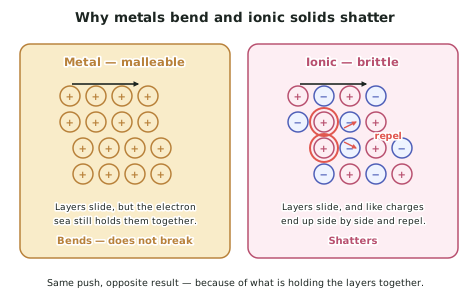
In a metal:
- The layers of positive ions slide over each other when a force is applied.
- The delocalised electrons move with them and keep surrounding every ion.
- The attraction between the ions and the electron sea is unchanged, and the electrons always lie between the positive ions, so like charges are never brought together.
- The metal changes shape and stays intact — it is malleable and ductile.
In an ionic solid:
-
The layers also slide, but the lattice is made of alternating positive and negative ions.
-
Sliding by one ion position brings like charges next to each other — positive beside positive, negative beside negative.
-
Like charges repel strongly, and there are no delocalised electrons to shield them.
-
The layers are pushed apart and the crystal splits — it is brittle.
-
This exact comparison is one of the most frequently asked Excellence questions in the standard.
Why covalent network substances are so hard
- Every atom is joined to its neighbours by strong covalent bonds in a rigid three-dimensional arrangement.
- To scratch or dent the substance you would have to break covalent bonds, which takes a great deal of energy.
- Diamond is the hardest natural substance for exactly this reason, and is used on drill bits and cutting tools.
Why molecular substances are soft
- The molecules are held to each other only by weak forces, so the layers of molecules slide past one another easily.
- Little force is needed to deform or break the solid — molecular solids are soft and crumble readily.
Worked ExampleExplaining opposite mechanical behaviour
Both aluminium and aluminium oxide are hard solids with high melting points. When struck with a hammer, aluminium flattens into a sheet while aluminium oxide shatters into pieces. Explain this difference.
Step 1 — Identify the bonding in each
Aluminium is a metal, so it has metallic bonding: a lattice of ions in a sea of delocalised electrons.
Aluminium oxide is a metal + non-metal compound, so it is ionic: a giant lattice of and ions in an alternating arrangement.
Step 2 — Note what the similarity tells us
Both have high melting points and are hard, which shows the forces holding both structures together are strong.
So the difference in behaviour cannot be explained by one having weaker bonding than the other. It must come from something else — the arrangement of charge.
Step 3 — Explain what happens in aluminium
The hammer blow makes the layers of ions slide over one another.
As they slide, the delocalised electrons move with them and continue to surround every ion. The electron sea always lies between the positive ions, so:
- the attraction between the ions and the electrons is maintained, and
- no two like charges are ever brought face to face.
The structure therefore holds together while changing shape — aluminium is malleable and flattens into a sheet.
Step 4 — Explain what happens in aluminium oxide
The blow again makes the layers slide. But this lattice alternates and , so sliding by one ion position brings next to and next to .
Like charges repel strongly, and there are no delocalised electrons to lie between them and shield the repulsion.
The layers are forced apart and the crystal splits along that plane — aluminium oxide is brittle and shatters.