Ionic bonding
What ionic bonding is
- Ionic bonding is the strong electrostatic attraction between oppositely charged ions.
- It forms between a metal and a non-metal.
- Electrons are transferred from the metal to the non-metal — not shared.
How the ions form
- Atoms are stable when their outer shell is full (usually 8 electrons — an octet).
- A metal has few outer electrons, so the quickest route to a full shell is to lose them.
- Losing negative electrons leaves the atom positively charged — a cation.
- A non-metal has nearly a full outer shell, so its quickest route is to gain electrons.
- Gaining negative electrons makes the atom negatively charged — an anion.
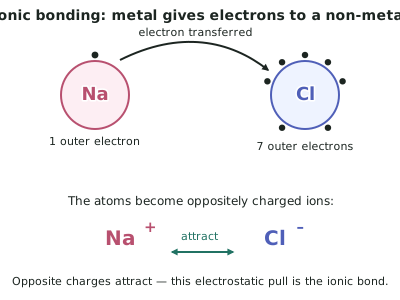
Worked through for sodium chloride:
- Sodium is 2,8,1 — one outer electron. It loses it → , leaving a full 2,8 shell.
- Chlorine is 2,8,7 — one short of a full shell. It gains that electron → , giving 2,8,8.
- The and now attract each other. That attraction is the ionic bond.
Working out the charge on an ion
- Group 1 metals lose 1 electron → 1+ (, )
- Group 2 metals lose 2 → 2+ (, )
- Group 13 metals lose 3 → 3+ ()
- Group 16 non-metals gain 2 → 2− (, )
- Group 17 non-metals gain 1 → 1− (, )
From charges to a formula
- The compound must be electrically neutral overall, so the total positive charge must equal the total negative charge.
- Find the charge on each ion.
- Balance them with the smallest whole numbers.
- Write the metal first, then the non-metal, with subscripts.
Worked through:
- Magnesium oxide — and . The 2+ and 2− already cancel, so MgO.
- Sodium oxide — and . You need two to cancel one , so .
- Aluminium chloride — and . You need three , so .
Why it forms a lattice, not a pair
- The attraction between an ion and an opposite charge acts in every direction at once.
- So an ion does not pair off with one partner — it attracts all its oppositely charged neighbours.
- The ions keep stacking into a giant ionic lattice, a regular repeating three-dimensional arrangement.
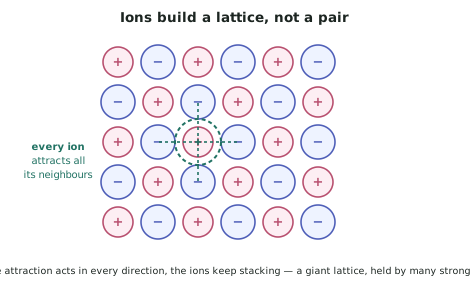
- There are no molecules in an ionic compound. "NaCl" is the ratio of ions, not a particle you could pick out.
- The lattice is held together by very many strong attractions, which is why ionic compounds have high melting points.
Worked ExamplePredicting an ionic formula
Calcium reacts with fluorine. Explain how the ions form, give the formula of the compound, and explain why it exists as a lattice rather than as pairs.
Step 1 — Identify the two elements
Calcium is a metal in group 2. Fluorine is a non-metal in group 17. Metal + non-metal → ionic bonding.
Step 2 — Work out how the ions form
Calcium has 2 outer electrons. It loses both to reach a full shell, becoming .
Fluorine has 7 outer electrons and needs one more. Each fluorine atom gains one electron, becoming .
Step 3 — Balance the charges
One carries 2+. Each carries only 1−, so you need two fluoride ions to cancel it:
Step 4 — Write the formula
Metal first, then the non-metal, with the numbers as subscripts:
Note that one calcium atom gives one electron to each of two fluorine atoms.
Step 5 — Explain the lattice
Each ion attracts the ions all around it, and each attracts the ions around it, in all directions. Because the attraction is not confined to one partner, the ions keep building outwards into a giant ionic lattice.