Energy and changes of state
Changing state takes energy too
- Melting, boiling, freezing and condensing all involve an enthalpy change, even though no chemical reaction happens.
- Energy is needed to separate the particles, or is released when they come together.
Which direction takes energy in
| Change | What happens to the particles | Energy | |
|---|---|---|---|
| melting (solid → liquid) | pulled apart a little | absorbed | positive |
| boiling / evaporating (liquid → gas) | pulled fully apart | absorbed | positive |
| condensing (gas → liquid) | come together | released | negative |
| freezing (liquid → solid) | come closer together | released | negative |
- Separating particles always needs energy in — those changes are endothermic.
- Bringing particles together always releases energy — those changes are exothermic.
The heating curve
-
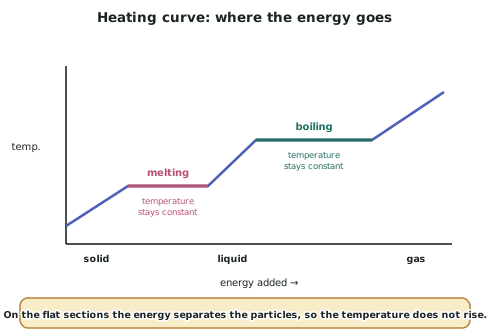
Heating a solid steadily gives a curve with two flat sections.
-
On the sloping parts, the energy makes the particles move faster, so the temperature rises.
-
On the flat parts, the energy is separating the particles during melting or boiling, so the temperature stays constant even though energy is still going in.
-
This is the most-asked feature of the graph: why does the temperature stop rising while the substance melts? Because all the energy is going into overcoming the forces between the particles, not into making them move faster.
Why boiling takes more energy than melting
- Melting only loosens the particles enough for them to slide past each other — they stay close together.
- Boiling separates them completely, so they are far apart and independent.
- Full separation takes much more energy, so the boiling plateau is longer than the melting plateau.
What is being overcome
For a molecular substance, the forces overcome during a change of state are the weak forces between the molecules — never the covalent bonds inside them.
- Boiling water gives steam, which is still molecules.
- Splitting water into hydrogen and oxygen is a chemical change and takes far more energy.
Freezing and condensing release energy
- These are the reverse changes, so the same amount of energy comes back out.
- for freezing water is the negative of for melting ice.
- This is why steam causes far worse burns than boiling water at the same temperature: as the steam condenses on skin it releases a large amount of extra energy.
Worked ExampleInterpreting a heating curve
A solid is heated at a steady rate and its temperature recorded. The temperature rises, then stays at 80 °C for four minutes, rises again, then stays at 218 °C for eleven minutes, then rises again.
(a) Identify what is happening during each flat section. (b) Explain why the temperature does not rise during them. (c) Suggest why the second flat section lasts much longer than the first.
(a) What the flat sections are
The first flat section, at 80 °C, is where the substance is melting — changing from solid to liquid. The melting point is therefore 80 °C.
The second flat section, at 218 °C, is where it is boiling — changing from liquid to gas. The boiling point is 218 °C.
(b) Why the temperature stays constant
Energy is still being supplied at a steady rate throughout, so the question is where that energy is going.
On the sloping parts of the curve, the energy increases the kinetic energy of the particles — they move faster, and the temperature rises.
On the flat parts, the energy is instead being used to overcome the forces holding the particles together, so that they can move apart into the new state. None of it goes into making the particles move faster, so the temperature stays constant until the change of state is complete.
(c) Why the boiling plateau is longer
The flat section is longer because more energy is required, and at a steady heating rate more energy means more time.
- Melting only has to loosen the particles enough for them to slide past one another. They remain close together, so only some of the forces between them need to be overcome.
- Boiling has to separate the particles completely, so that they become far apart and independent. All of the forces between them must be overcome.
Because complete separation requires considerably more energy than loosening, the boiling plateau lasts about eleven minutes compared with four for melting.