Bond enthalpy calculations
Breaking and making bonds
Two facts drive every calculation on this page:
- Breaking bonds requires energy — you must pull the atoms apart. Endothermic, energy in.
- Making bonds releases energy — the atoms settle into a lower-energy arrangement. Exothermic, energy out.
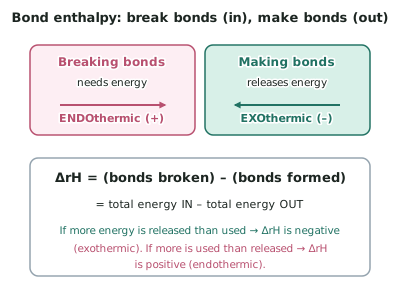
What decides the sign of a reaction
Every reaction breaks the reactants' bonds and makes new ones in the products. Whether it is exothermic or endothermic depends on which is bigger:
- More energy released making bonds than absorbed breaking them → exothermic, negative.
- More energy absorbed breaking bonds than released making them → endothermic, positive.
The relationship
-
— total bond enthalpy of all bonds in the reactants.
-
— total bond enthalpy of all bonds in the products.
-
A useful way to remember the order: "broken minus formed" — reactants first, products second, same order as the equation.
Bond enthalpy
- Bond enthalpy is the energy needed to break one mole of a particular bond.
- It is always quoted as a positive number, because breaking always takes energy in.
- Typical values (in ): C–H 413, C–C 347, C=C 614, O=O 498, C=O 805, O–H 464, H–H 436.
- Stronger bonds have larger values, so a C=C takes more energy to break than a C–C.
The method
- Draw or list every bond in the reactants, and every bond in the products.
- Count them carefully, including the coefficients in the equation.
- Add up the bond enthalpies for the reactants — this is bonds broken.
- Add up the bond enthalpies for the products — this is bonds formed.
- Subtract: broken − formed.
- Check the sign and give units.
Counting bonds without missing any
This is where nearly all the marks are lost, so be systematic:
- Write out the structure of each molecule rather than working from the formula.
- Multiply by the coefficient: contains 4 O–H bonds, not 2.
- Count every bond, including all the C–H bonds in an organic molecule.
- Tally them in a list before you add anything up.
Worked ExampleA full bond enthalpy calculation
Use the bond enthalpies below to calculate for the combustion of methane, and state whether the reaction is exothermic or endothermic.
C–H = 413, O=O = 498, C=O = 805, O–H = 464 (all )
Step 1 — List the bonds in the reactants
— the carbon is bonded to four hydrogens: 4 × C–H
— each oxygen molecule has one double bond, and there are two molecules: 2 × O=O
Step 2 — List the bonds in the products
— the structure is , so there are 2 × C=O
— each water molecule has two O–H bonds, and there are two molecules: 4 × O–H
Step 3 — Add up the bonds broken (reactants)
Step 4 — Add up the bonds formed (products)
Step 5 — Subtract, in the right order
Step 6 — Interpret the result
The value is negative, so the reaction is exothermic.
This makes sense: more energy was released forming bonds (3466 kJ) than was absorbed breaking them (2648 kJ), so there is a net release of energy — which is exactly what you expect from burning a fuel.