Enthalpy calculations with amount of substance
What ΔrH actually refers to
- A quoted applies to the exact amounts shown in the balanced equation.
- This means 890 kJ is released when 1 mol of burns.
- React a different amount and the energy scales in proportion.
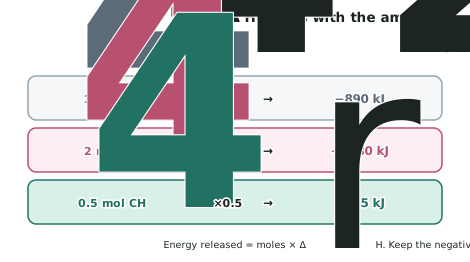
- n is the number of moles of the substance the refers to.
Finding the number of moles
The resource booklet gives you the relationships; the skill is choosing the right one.
-
From a mass:
- n — amount, in mol
- m — mass, in g
- M — molar mass, in (add up the atomic masses from the periodic table)
-
From a solution:
- c — concentration, in
- V — volume, in L (divide millilitres by 1000)
The method
- Write the balanced equation with its .
- Identify which substance the refers to (usually the one with a coefficient of 1).
- Calculate n for that substance.
- Multiply: energy .
- Check the sign, and give the answer to 3 significant figures with units.
Using the mole ratio
- If the amount you are given is for a different substance, convert using the ratio in the equation first.
- Example: in , 2 mol of react per 1 mol of . So 0.40 mol of corresponds to mol of , and it is that 0.20 mol you multiply by .
Watching the units
- Mass in grams, not kilograms.
- Volume in litres for — 250 mL is 0.250 L.
- in , so the energy comes out in kJ.
Worked ExampleCalculating energy released from a mass
Propane burns according to the equation below. Calculate the energy released when 22.0 g of propane is burned completely.
Step 1 — Identify what ΔrH refers to
The coefficient of is 1, so is the energy released per mole of propane burned.
So we need the number of moles of propane.
Step 2 — Work out the molar mass of propane
contains 3 carbons and 8 hydrogens:
Step 3 — Calculate the number of moles
Keep the extra digits for now and round only at the end.
Step 4 — Multiply by ΔrH
Step 5 — Round and interpret the sign
To 3 significant figures: .
The negative sign means energy is released, so the question's phrase "energy released" is answered as a positive quantity of 1110 kJ.