Metallic bonding
What metallic bonding is
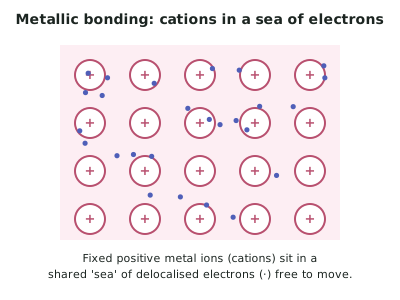
- Metallic bonding is the attraction between a lattice of positive metal ions and a sea of delocalised electrons.
- It occurs in metals and alloys — between metal atoms only.
How it works
-
Metal atoms have few outer electrons and hold onto them loosely.
-
Each atom releases its outer electrons into a shared pool.
- Having lost electrons, what is left is a positive metal ion (cation).
-
Those released electrons are delocalised — they belong to no particular atom and are free to move throughout the whole structure.
-
The fixed positive ions are all attracted to the negative electron sea around them, and that attraction holds the metal together.
-
"Delocalised" is the key word. It means not tied to one atom. Use it.
Why this explains what metals do
Every characteristic property of a metal comes straight from this picture, which is why it is worth learning properly:
- Conducts electricity (as a solid and when molten) — the delocalised electrons are free to move, and moving charge is a current.
- Conducts heat well — the mobile electrons carry energy through the structure quickly.
- Malleable and ductile — the layers of ions can slide over each other, and the electron sea moves with them, so the metal changes shape without breaking.
- High melting point — there are many strong attractions between the ions and the electron sea, so a lot of energy is needed to separate them.
- Shiny — the delocalised electrons reflect light.
Comparing the three types of bonding
| Ionic | Covalent | Metallic | |
|---|---|---|---|
| Between | metal + non-metal | non-metal + non-metal | metal only |
| Electrons are | transferred | shared between two atoms | delocalised across the whole structure |
| Particles present | positive and negative ions | molecules (atoms sharing) | positive ions + electron sea |
- The way to identify the bonding is simply to look at the elements involved:
- metal + non-metal → ionic
- two non-metals → covalent
- metal(s) only → metallic
Why metals do not shatter
-
In an ionic solid, sliding the layers brings like charges next to each other, and they repel — the crystal splits.
-
In a metal, the ions are all positive and the electron sea sits between them everywhere. Sliding the layers changes nothing about the attraction, so the metal bends instead of breaking.
-
This comparison is a very common Excellence question and is covered in full on the hardness and malleability page.
Worked ExampleExplaining two metallic properties
Copper is used for electrical wiring. Explain, in terms of metallic bonding, why copper conducts electricity and why it can be drawn out into a thin wire without snapping.
Step 1 — Describe the bonding present
Copper is a metal, so it has metallic bonding: a lattice of positive copper ions surrounded by a sea of delocalised electrons that came from the atoms' outer shells.
Step 2 — Explain the electrical conductivity
An electric current is a flow of charge.
In copper the delocalised electrons are not held by any one atom and are free to move through the whole structure. When a voltage is applied, these electrons drift through the metal, carrying charge — so copper conducts electricity.
Note that the positive ions themselves stay fixed in place; it is only the electrons that move.
Step 3 — Explain the ductility
Being drawn into a wire means the metal is ductile, which requires the structure to change shape without breaking.
When a force is applied, the layers of positive ions slide over one another. As they slide, the electron sea moves with them and continues to surround every ion.
So the attraction between the positive ions and the delocalised electrons is maintained throughout — no repulsion is ever created between like charges, because the electrons keep the positive ions apart. The metal therefore deforms rather than fracturing.