Covalent bonding
What covalent bonding is
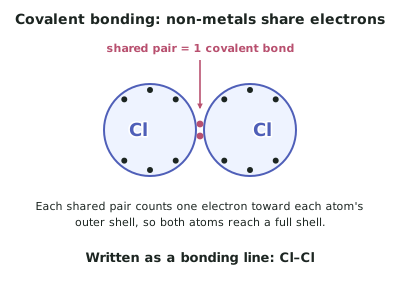
- A covalent bond is a shared pair of electrons between two atoms.
- It forms between two non-metals.
- Neither atom can give electrons away easily, so instead they share — and both count the shared pair towards a full outer shell.
Why the shared pair holds the atoms together
- The shared electrons sit between the two nuclei.
- Both positive nuclei are attracted to the same negative pair.
- That shared attraction is what holds the atoms together — it is the bond.
Single, double and triple bonds
- Atoms can share more than one pair if they need more electrons to fill their shells.
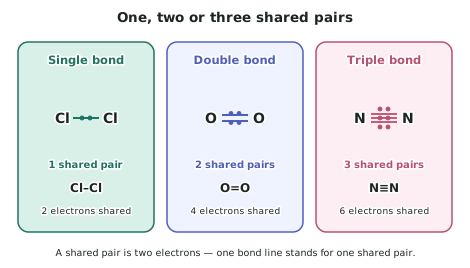
| Bond | Pairs shared | Electrons shared | Drawn as | Example |
|---|---|---|---|---|
| single | 1 | 2 | one line | |
| double | 2 | 4 | two lines | |
| triple | 3 | 6 | three lines |
- One line always means one shared pair, which is two electrons.
- More shared pairs make a shorter, stronger bond — a triple bond is harder to break than a single one.
Bonding pairs and lone pairs
- Bonding pair — a pair of electrons shared between two atoms.
- Lone pair — a pair of outer electrons that stays on one atom and is not shared.
- Lone pairs still take up space around the atom, which matters a lot when you work out molecular shape.
Worked through:
- In water, oxygen has two bonding pairs (one to each hydrogen) and two lone pairs.
- In ammonia, nitrogen has three bonding pairs and one lone pair.
- In methane, carbon has four bonding pairs and no lone pairs.
How many bonds an atom makes
- An atom forms enough bonds to reach a full outer shell, which usually means 8 electrons (2 for hydrogen).
- The count is predictable from the group:
| Atom | Outer electrons | Bonds it forms |
|---|---|---|
| H | 1 | 1 |
| C | 4 | 4 |
| N | 5 | 3 |
| O | 6 | 2 |
| F, Cl, Br, I | 7 | 1 |
- This table is what makes structures checkable: if your drawing gives nitrogen four bonds, it is wrong.
Molecules
- A molecule is a discrete group of atoms joined by covalent bonds.
- Unlike an ionic lattice, a molecule is a real, countable particle — you can point at one .
- Molecules are attracted to each other only weakly, by forces between molecules, which is a separate idea from the strong bonds inside.
Worked ExampleWorking out the bonding in a molecule
Nitrogen gas exists as . Explain why the two nitrogen atoms are joined by a triple bond, and state how many bonding pairs and lone pairs each nitrogen atom has.
Step 1 — Count the outer electrons
Nitrogen is in group 15, so each atom has 5 outer electrons.
Step 2 — Work out how many more it needs
A full outer shell holds 8. Each nitrogen therefore needs 3 more electrons.
Step 3 — Decide how many pairs must be shared
Neither atom can gain electrons outright — both are non-metals — so they must share. Each atom needs 3 extra electrons, and each shared pair gives one extra electron to each atom.
So the two atoms must share three pairs — a triple bond.
Step 4 — Check the electron count
Each nitrogen contributes 3 of its own electrons to the sharing and keeps 2 to itself.
Counting around one nitrogen: 6 shared electrons (from the three shared pairs) + 2 unshared = 8. ✓ A full outer shell.
Step 5 — Count the pairs on each atom
- Bonding pairs: 3 — the three pairs of the triple bond.
- Lone pairs: 1 — the two electrons that were not shared.