Electrical conductivity
The one rule
A substance conducts electricity only if it contains charged particles that are free to move.
Both halves matter:
- Charged particles — ions or electrons. Neutral atoms and molecules carry no charge.
- Free to move — a charged particle locked in place cannot carry a current.
Every conductivity question is answered by checking these two conditions.
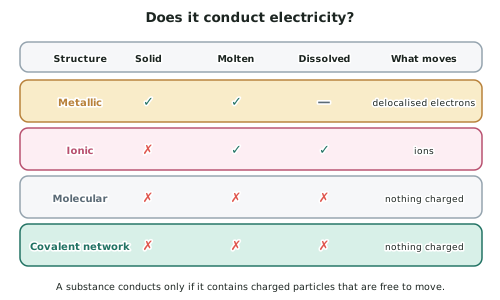
The full picture
| Structure | Solid | Molten | Dissolved | What carries the charge |
|---|---|---|---|---|
| Metallic | ✓ | ✓ | — | delocalised electrons |
| Ionic | ✗ | ✓ | ✓ | the ions |
| Molecular | ✗ | ✗ | ✗ | nothing — molecules are neutral |
| Covalent network | ✗ | ✗ | ✗ | nothing — atoms are neutral |
Metals — conduct always
- Metals contain delocalised electrons that are free to move through the whole structure.
- They are mobile whether the metal is solid or molten, so a metal always conducts.
- The positive ions stay in place — it is only the electrons that move.
Ionic compounds — conduct only when the ions can move
This is the pattern examiners test most, so learn all three states:
-
Solid — the ions are held in fixed positions in the lattice. They are charged, but they cannot move, so it does not conduct.
-
Molten — the lattice has broken down and the ions are free to move, so it does conduct.
-
Dissolved in water — the lattice breaks up and the ions separate and move through the solution, so it does conduct.
-
Note the charged particles are present in all three cases. It is only their mobility that changes.
Molecular and covalent network — never conduct
-
Molecular substances are made of neutral molecules. There are no ions and no delocalised electrons, so there is nothing charged to move in any state.
-
Covalent network substances are made of neutral atoms with all their electrons held in fixed covalent bonds. Nothing is free to move, so they do not conduct — despite their giant structure.
-
Graphite is the exception. It is a covalent network in which each carbon bonds to only three others, leaving one electron per atom delocalised, so graphite does conduct. It is worth knowing but is a special case.
How to write the answer
-
Say what charged particles are present — ions, delocalised electrons, or none.
-
Say whether they can move in the state being asked about.
-
Give the verdict.
-
An answer that says only "it has ions so it conducts" is incomplete, because a solid ionic compound also has ions and does not conduct.
Worked ExampleExplaining conductivity across three states
Explain why solid sodium chloride does not conduct electricity, but molten sodium chloride and sodium chloride solution both do. Then explain why solid copper conducts but solid sulfur does not.
Step 1 — Establish what particles sodium chloride contains
Sodium chloride is ionic. It contains and ions — charged particles are definitely present in every state.
So the question is entirely about whether those ions can move.
Step 2 — Solid sodium chloride
In the solid, the ions are held in fixed positions in the giant ionic lattice by strong electrostatic attractions. They can vibrate, but they cannot move from place to place.
With no charged particles free to move, the solid does not conduct.
Step 3 — Molten sodium chloride
Melting supplies enough energy to overcome the attractions holding the lattice together. The ions are released from their fixed positions and become free to move.
Mobile charged particles → molten sodium chloride conducts.
Step 4 — Sodium chloride solution
Dissolving also breaks up the lattice, separating the ions and letting them move freely through the water.
Mobile charged particles → the solution conducts.
Step 5 — Copper compared with sulfur
Copper is metallic: a lattice of positive ions in a sea of delocalised electrons. Those electrons are not attached to any one atom and are free to move even in the solid, so solid copper conducts.
Sulfur is simple molecular, made of neutral molecules. There are no ions and no delocalised electrons — nothing charged exists to move, in any state — so solid sulfur does not conduct.