Lewis structures
What a Lewis structure shows
- A Lewis structure is a diagram showing all the outer-shell electrons of a molecule.
- Bonding pairs are drawn as a line between two atoms (or as two dots).
- Lone pairs are drawn as a pair of dots on the atom they belong to.
- Every atom should end up with a full outer shell — 8 electrons for most atoms, 2 for hydrogen.
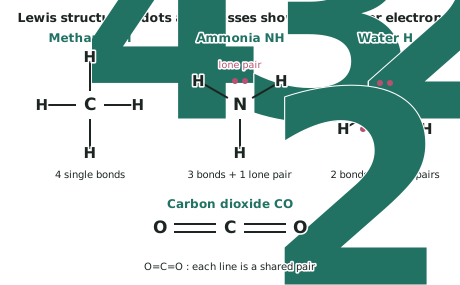
At Level 2 you only ever draw simple molecules — ones with no more than four electron pairs around any atom.
Drawing one, step by step
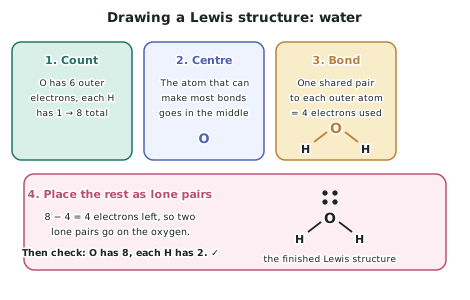
- Count the total outer-shell electrons — add up the group contribution of every atom.
- Choose the central atom — the one that can form the most bonds (never hydrogen, which only forms one).
- Join the central atom to each outer atom with a single bond. Each bond uses 2 electrons.
- Place the electrons that are left as lone pairs, filling the outer atoms first, then the central atom.
- Check every atom has a full shell. If the central atom is short, change a lone pair into another bonding pair — that makes a double or triple bond.
Counting outer electrons
| Group | Atoms | Outer electrons |
|---|---|---|
| 1 | H | 1 |
| 14 | C | 4 |
| 15 | N, P | 5 |
| 16 | O, S | 6 |
| 17 | F, Cl, Br, I | 7 |
- For a negative ion, add one electron per negative charge. For a positive ion, subtract one per positive charge.
Bonding pairs and lone pairs — count both
You will need both numbers on the next page to work out the shape, so record them as you go:
| Molecule | Bonding pairs | Lone pairs on the central atom |
|---|---|---|
| 4 | 0 | |
| 3 | 1 | |
| 2 | 2 | |
| 2 (both double) | 0 |
- Careful: for shape purposes a double bond counts as one region of electrons, not two.
When you need a double bond
- If the central atom does not reach 8 electrons after you place the lone pairs, it needs more sharing.
- Move a lone pair from an outer atom into the bond to make a double (or triple) bond.
Worked through for carbon dioxide:
- Total outer electrons: C gives 4, each O gives 6 → .
- Single bonds O–C–O use 4, leaving 12 for lone pairs.
- Putting three lone pairs on each oxygen uses all 12 — but carbon then has only 4 electrons. Not enough.
- So move one lone pair from each oxygen into the bond, making two double bonds: .
- Now carbon has 8 ✓ and each oxygen has 4 bonding + 4 lone = 8 ✓.
Worked ExampleDrawing a Lewis structure
Draw the Lewis structure of ammonia, , showing all outer electrons, and state the number of bonding pairs and lone pairs on the nitrogen.
Step 1 — Count the total outer electrons
Nitrogen is in group 15 → 5 outer electrons. Each hydrogen has 1, and there are three → 3.
That is 4 pairs to place.
Step 2 — Choose the central atom
Hydrogen can only form one bond, so it cannot be central. Nitrogen goes in the middle, with the three hydrogens around it.
Step 3 — Make a bond to each hydrogen
Three N–H single bonds use 3 pairs = 6 electrons.
Each hydrogen now has 2 electrons — a full shell for hydrogen. ✓
Step 4 — Place the electrons that are left
That is one pair, and there is nowhere for it to go except the nitrogen. It becomes a lone pair on the nitrogen, drawn as two dots.
Step 5 — Check every atom
Nitrogen: 3 bonding pairs (6 electrons) + 1 lone pair (2 electrons) = 8 ✓ Each hydrogen: 1 bonding pair = 2 ✓
Step 6 — Answer the question asked
- Bonding pairs: 3
- Lone pairs: 1